


The Self-Reproducing Inflationary Universe
- Pedro

- Sep 18, 2020
- 3 min read
*Note: this article is about a hypothesis: the self-reproducing inflationary universe. This hypothesis is based on the theory of inflation. We must not mistake the concepts hypothesis and theory, Hypothesis are ideas which do not have been given enough evidence to be proven truths. On the other hand, theories are ideas supported by firm evidence, thus considered as truths.
The inflation period was a time in the universe`s history (from the second t=10^(-36) to t=10^(-32) after the Big Bang) in which the universe went through a huge expansion in its size. In this tiny time interval, the universe had its size increased by a factor of 10^(26). After the inflation era ended, the universe continued (and will always continue) to expand, but at a slower rate.
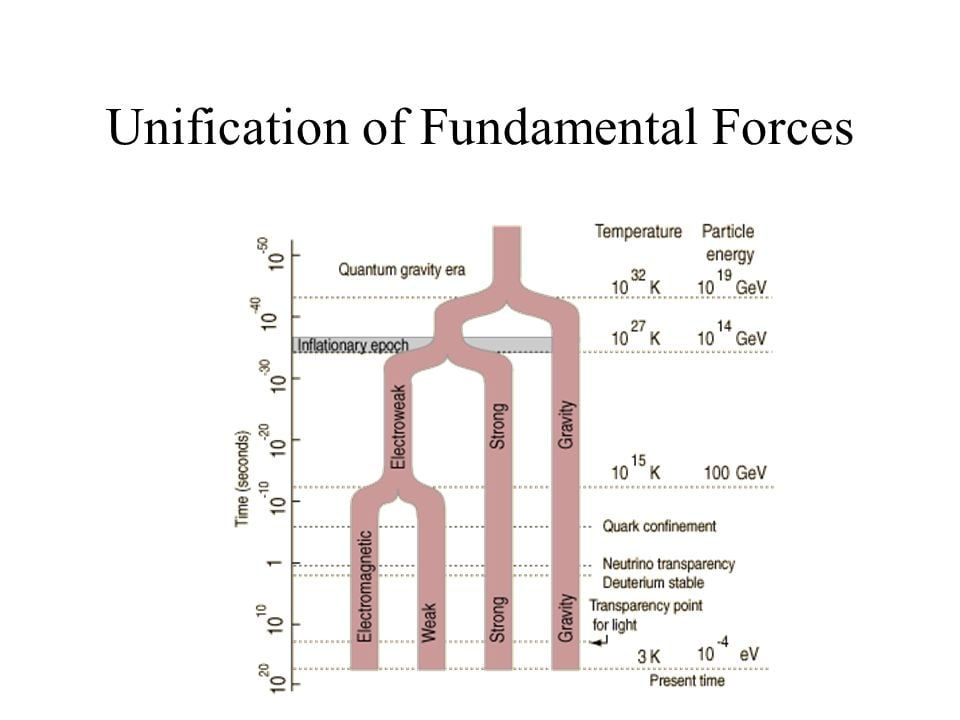
Right after the Big Bang, all the four forces of nature are believed to have been unified, that is, they were all contained within a single force (there is certain skepticism regarding gravity). There is no way to distinguish the forces if they are unified. When the universe expanded and cooled down, the forces started to set apart, a result of the appearance of the a scalar field. The process "separation" of the forces of nature is named "break of symmetry". Photo 2 shows the unification and separation of the forces of nature.
But what are scalar fields? Put simply, a scalar field is a category of "physical fields". The Higgs field is the most famous example of a scalar field. The scalar field which we are interested in this cosmology article is the so-called "inflation field". The inflation field is a hypothetical field, that is, its existence has not been proved.
How does the inflation field behave? According to General Relativity, the expansion of the universe is directly proportional to the square root of its expansion:
(expansion of the universe)∝√(density of the universe)
Ordinary matter (such as protons, neutrons, electrons, atoms, molecules...) would be rapidly "diluted" in the rapid expansion of the universe, decreasing the density of the universe exponentially. However, because of the mass-energy equivalence (𝐸=𝑚𝑐^2), the potential energy of the inflation field also contributes to the net density of the universe, since this energy can be converted in mass according to the equation presented (it is similar to think that when we talk about the spacetime tissue, mass, as well as energy, can cause the deformation of the tissue). In case the potential energy of the inflation field reaches its minimum value, the field vanishes. With the absence of the inflation field, the inflation period ends.
The "key point" of the self-reproducing inflationary universe theory is that inflation creates certain inhomogeneities in space via quantum vacuum fluctuations (particles that are created and annihilated spontaneously, through all space, for short periods of time). Those fluctuations modify the value of the inflation field, making it possible for the field to have its potential energy increased. If this happens, a new inflation period will be started, whereas this inflation will have new fluctuations which can also result in new inflations and so on. The product is an inflation cycle, as represented in photos 3 and 4.
Foto 1: Artistic conception on inflation
Foto 2: diagram showing the unification and separation of the forces of nature
Fotos 3 e 4: diagrams showing the "inflation cycle"
Material de referência: The Self-Reproducing Inflationary Universe (Andrei Linde)
The evolving universe (S. George Djorgovski)
Origens; Astrophysics for people in a hurry (Neil deGrasse Tyson)
The Universe in a Nutshell; A brief history of time (Stephen Hawking)
50 astronomy ideas you really have to know (Giles Sparrow)
Do átomo ao buraco negro (Schwarza)






Comments