


Special relativity
- Pedro

- Jul 25, 2020
- 4 min read
In the "miraculous year", 1905, Albert Einstein had published four of the most important scientific articles in history; among them, special relativity.
One of the main goals of relativity is to explain how certain "points of view" (formally known as reference frames) relate. The most traditional example to consider is the case of two observers and a train. Inside the train there is an observer, Bonifacio. Off the train, next to the rails, is Pedro. If Bonifacio, inside the wagon, threw a ball with velocity v, the ball, in relation to him, would continue to have velocity v. For Pedro, however, the ball would have velocity v+v_train. What if, instead of the ball, Bonifacio had fired a laser beam inside the train? Would the beam velocity for Pedro be c (speed of light)+v_train? Another illustrative scenario is that of two cars approaching with their headlights on. Would the speed of light, emitted by the headlight, be c+v_approach*?
*v_approach is the approach velocity between the two vehicles, that is, v_approach=v_car1+v_car2
Special relativity tells us that those velocities would not be measured. For any and all reference frames, the speed of light is constant, having value c (considering the vacuum). This rather simple concept established serious implications in the aforementioned causality. But what does causality mean? Causality is a principle that says that, given two correlated events, say A and B, event A is responsible for event B. An example is advantageous for understanding causality. An archer performs an A event, which is to shoot an arrow toward a target. Event B is the target being hit. Event B was caused by event A, and the time interval between these two events depends on the speed of the arrow. The imposition of constancy and maximum limit of light velocity in vacuum implies that no event can influence other at a speed higher than that of light. Thus we can see the importance of causality in relativity (and in physics in general).
Special relativity has also brought several peculiar aspects, such as time dilation and length contraction. The mental experiment of firing a laser at a spacecraft, as shown in photo 4, describes the temporal dilation. It is noted that the distances traveled by the light beam appear to be different, but because the speed of light is constant, the only factor that can change is the time interval, as shown in photos 4 to 7. Thus, the faster an object is moving through space, the slower it will be moving through time, according to equation t=t_0/√(1-v^2/c^2), derived from photos 4,5,6 and 7. The length contraction occurs in a similar way, and for an observer in a reference frame distinct from the object's referential frame (like an astronaut in space observing a spacecraft), the higher the speed of the object the more it seems to have its length contracted in the direction in which it is traveling (see photo 7). It is emphasized the fact that the previous effects, called relativistic effects, are perceptible to speeds comparable to that of light (for everyday speeds these effects are totally negligible).
Finally, special relativity brought the most famous equation in history: E=mc^2. It is likely that even a person who has no affinity for physics recognizes this memorable relationship. But again, what does it mean and what is the reason for its importance and "status"? The name of Einstein's famous equation is "mass-energy equivalence", pointing out that these two amounts are equivalent. Mass can be transformed into energy (according to E=mc^2) and energy can be transformed into mass (as per m=E/c^2). This principle is responsible for making the Sun and all stars shine (by making small portions of the mass of particles involved in nuclear fusion turn into huge amounts of energy) and is also the foundation for the functioning of synchrotron-like particle accelerators (particles gain kinetic energy, i.e. velocity, collide and can transform part of the collision`s energy into mass in the form of "new particles").
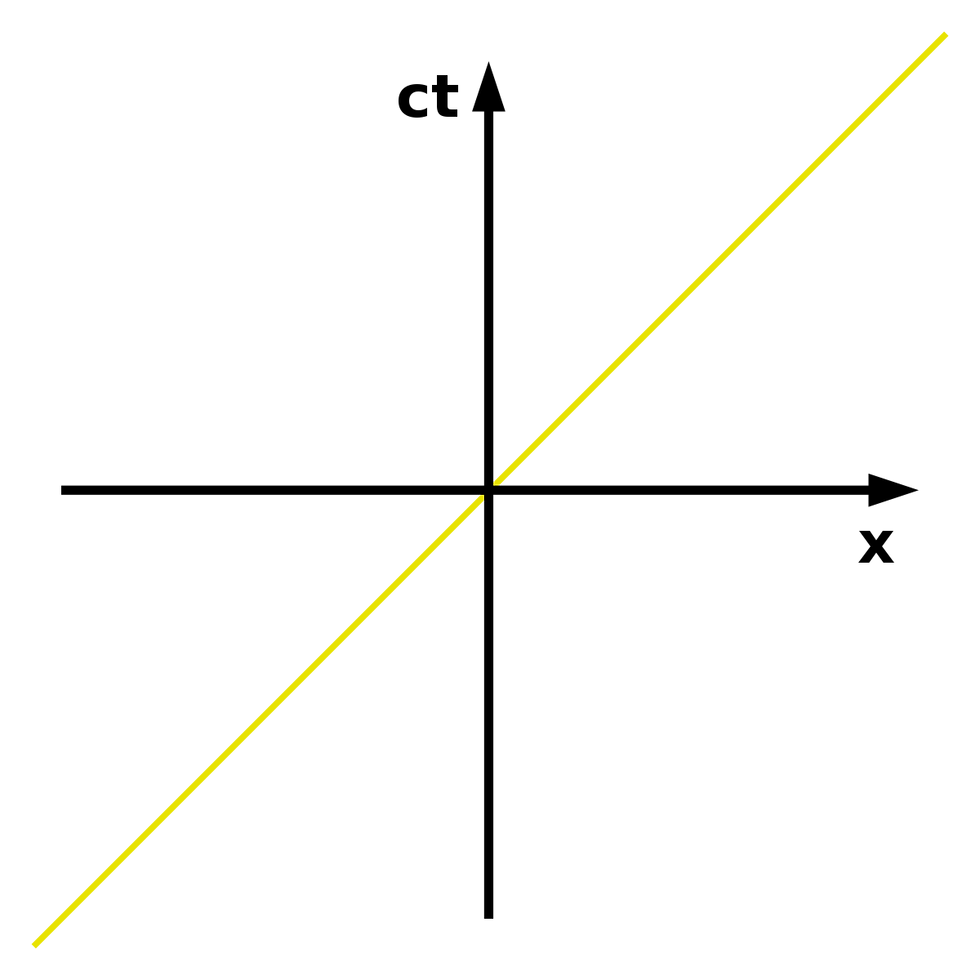
Relativity also has the so-called Minkowski diagrams, which picture graphically what space-time looks like. In this diagram, the vertical axis represents time and the horizontal axis represents space (in its entirety). The lines described by an object in the space-time diagram are called "world lines". A person sat on the couch would depict a vertical line because that one is not moving through space, but is experiencing the time passage. As an object`s world line starts getting more horizontal, the object starts experiencing "less time" (the "clock" for this object starts running slower), in other words, we get the time dilation phenomenon. In Minkowski`s diagram, the units are chosen in such a way that light, travelling at c, marks a line with an angle of 45 degrees, as shown in photo 2 (see photo 3 for the reason behind such specificity in the angle).
Photo 1: Albert Einstein
Photo 2: Minkowski`s diagram
Photo 3: Reasoning regarding light`s world line
Photos 4-7: Time dilation derivation
Photo : Relativistic contraction
Material de referência: Física para cientistas e engenheiros volume 3 (Paul A. Tipler e Gene Mosca) Meus últimos anos (Albert Einstein) https://www.youtube.com/watch?v=toGH5BdgRZ4 (Aulas do Professor Leonard Susskind) https://www.youtube.com/watch?v=1rLWVZVWfdY&list=PLoaVOjvkzQtyjhV55wZcdicAz5KexgKvm






Comments