


Relativity: Cosmological Constant X Dark Energy
- Pedro

- Jan 23, 2021
- 5 min read
Although astronomy is one of the oldest and most studied sciences, in the early 20th century, little was known about cosmology, a field of study involving the "big questions" such as the shape of the universe, how it behaves on large scales, what was its origin, etc. Before Edward Hubble discovered the expansion of the cosmos, it was believed that the universe was static (its size did not change), just like Immanuel Kant's view in the 18th century. The revolution in cosmology would come later, in 1915, with the publication of general relativity by Albert Einstein. Yet, general relativity took ten years to be developed, with Einstein having several misadventures along the way, such as the universe's collapse. If you drop two marbles in a funnel-shaped sink, the shock between them will be imminent, given the curved path they must follow. If, in some way, the sink started to expand in size the moment you release the balls, the collision would be difficult or even impossible, depending on how effective the sink's expansion is. As Einstein's theory understands space as a geometry curved by massive objects and/or energy, the physicist understood that the universe would collapse if it were stationary, in the same way as the inevitable shock of the marbles. But wait, we are here, meaning that the universe didn't collapse. How to explain the stability? Perhaps it is expanding just like the sink in our analogy? This thought was regarded as absurd since Hubble's discovery had not yet been made. Thereafter, Einstein chose to adopt a correction parameter called the "cosmological constant," denoted by Λ. In other words, the cosmological constant had the function of "deleting" the effect of the collapse of the universe.
Before we understand more about the cosmological constant, we must have some knowledge about field equations, the basis of general relativity.
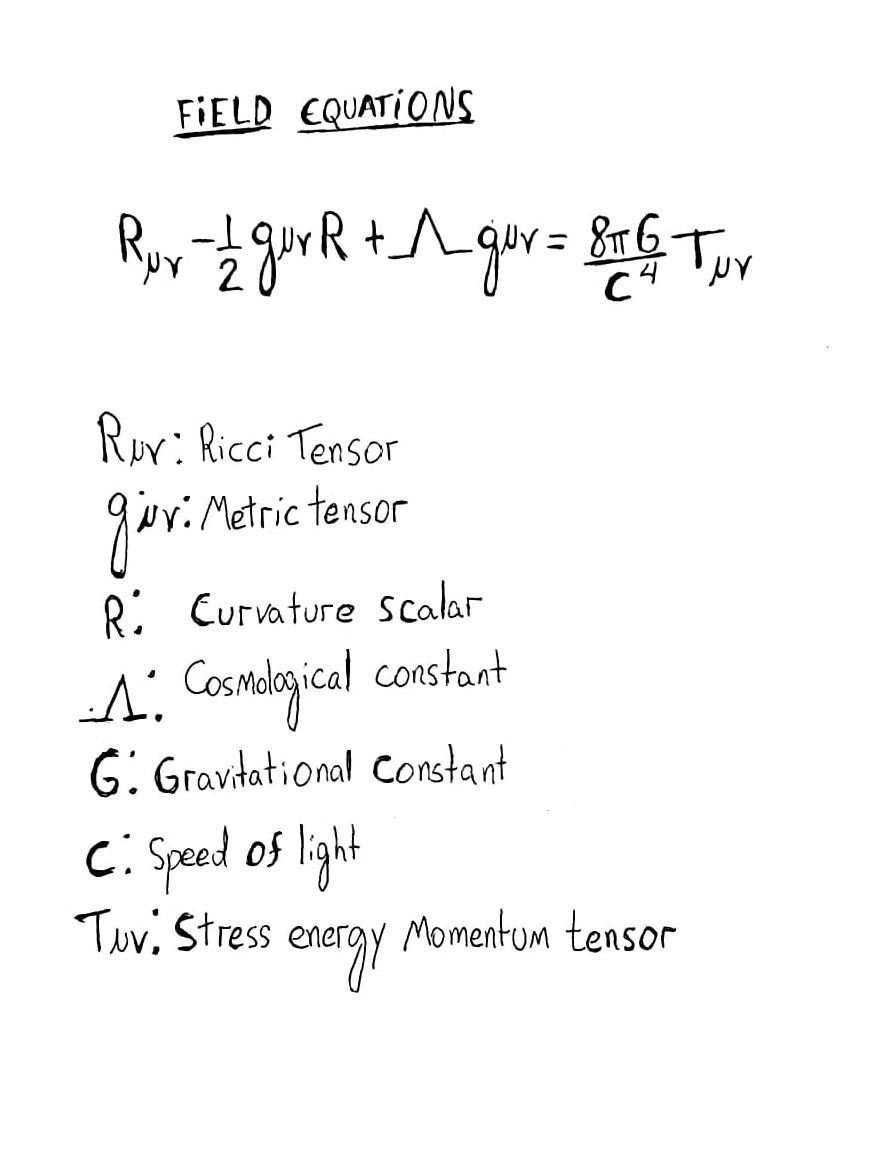
Photo 1
It may be a surprise, but the photo above illustrates sixteen equations, not one. This is because the entities containing the subscripts are not scalars, nor vectors, but tensors. The subscripts µ and ν indicate the spatial and temporal coordinates, as shown below.
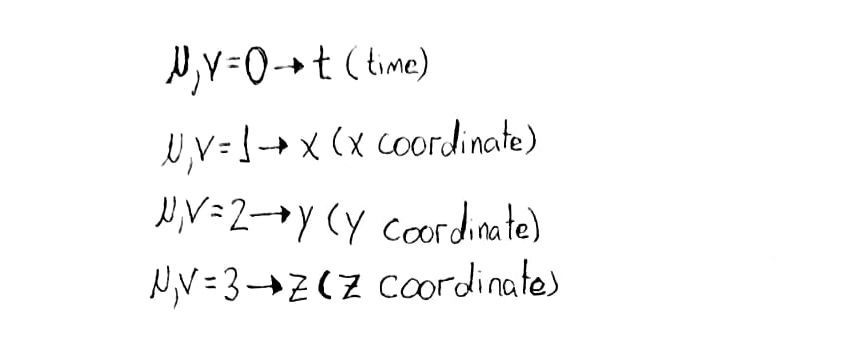
Photo 2
However, due to the possibility of equivalent combinations of µ and ν, six equations are repeated. Therefore, there are ten independent field equations. See the repetitions below:

Photo 3

Photo 4

Photo 5
Each equation generated is a differential equation, which has derivatives in its constitution. Generally, differential equations are required to study the variation of some phenomenon, as, for example, the change of speed. When solving a differential equation, we obtain a function as its solution (similarly to when we find the "X" as the solution to a conventional equation). In a differential equation where the derivative is related to velocity, we have acceleration as the solution. Besides, differential equations can tell us how the system under consideration will behave in the future, starting with only the system's initial conditions. However, these powerful mathematical tools come at a cost: the constant of integration. To solve differential equations, we have to perform the opposite process of the derivatives, which are the integrals. When performing an indefinite integral, we always obtain an arbitrary constant whose value depends on other techniques to determine, that is, when it is possible to determine it. Since relativity gives us ten independent differential equations (which are not repeated), we will have a set of constants to determine. The problem is that, as stated, the determination of such constants is not always possible. In the same way that the set of equations produces the generalized field equation (photo 2), these integration constants produce a "generalized constant," which is precisely the cosmological constant.
We now know a little about the main equations of relativity; however, the question remains: if the universe is really expanding, as was later demonstrated by Hubble, then the value of these integration constants/cosmological constant must be zero, right? Not necessarily. If the value is zero, we have either an expanding universe (consistent with the observations) or accelerated contraction (different from the collapse induced by gravity mentioned at the beginning of the article). If Λ were positive, the expansion of the universe would be accelerated and, if Λ were negative, the expansion of the universe would be slowed. Note that the value of the constants can be any number, +0.00000000000001, or, -0.03432495, or 0, or any other, as long as it does not have a significant magnitude, which would contradict the observations of the expanding universe. However, we have no way of knowing precisely the value of Λ, due to the uncertainties (degree of error) in the measurement attempts. It is like when we measure a person's height. We can use a tape measure, but we will not know the height accurately within every millimeter. We may end up measuring a little higher or lower than the actual height. This error is called measurement uncertainty. Thus, as Λ is expected to be a small value, virtually any uncertainty is "catastrophic" (the uncertainty itself may be greater than the value of Λ itself).
So far, we have talked extensively about Λ, but nothing about dark energy. What would that dark energy be? The answer is undoubtedly worthy of a Nobel. Nobody knows. It is factual that it exists due to its remarkable role in the expansion of the universe. If it weren't for it, the universe would have collapsed shortly after the Big Bang due to the gravitational pull of the entire universe being concentrated in a volume much smaller than a tennis ball. Dark energy offers "vitality" for the expansion of the universe, accelerating it. It would be something like a "negative pressure" where the force is exerted outwards and not inwards (causing expansion rather than contraction). Here we already see a similarity between dark energy and the positive cosmological constant: both favor the cosmos' expansion.
Despite being concepts connected to energy, dark energy and the cosmological constant differ mainly in how energy is attributed. The "conventional" energy is linked to physical systems, such as photon energy, which decreases as the universe expands due to redshift (already discussed here in the article about "The Self-Reproducing Inflationary Universe"). As for dark energy and the cosmological constant, the "energies" are attributed to the space itself (and not to the entities that are inserted in it).
Furthermore, just as there is difficulty in measuring Λ, there is difficulty in measuring dark energy. Measurement uncertainties suggest that dark energy density may not be constant, contrary to the "constancy of the cosmological constant." However, more accurate data is needed before any statement.
The mathematical distinction between Λ and dark energy is shown below:
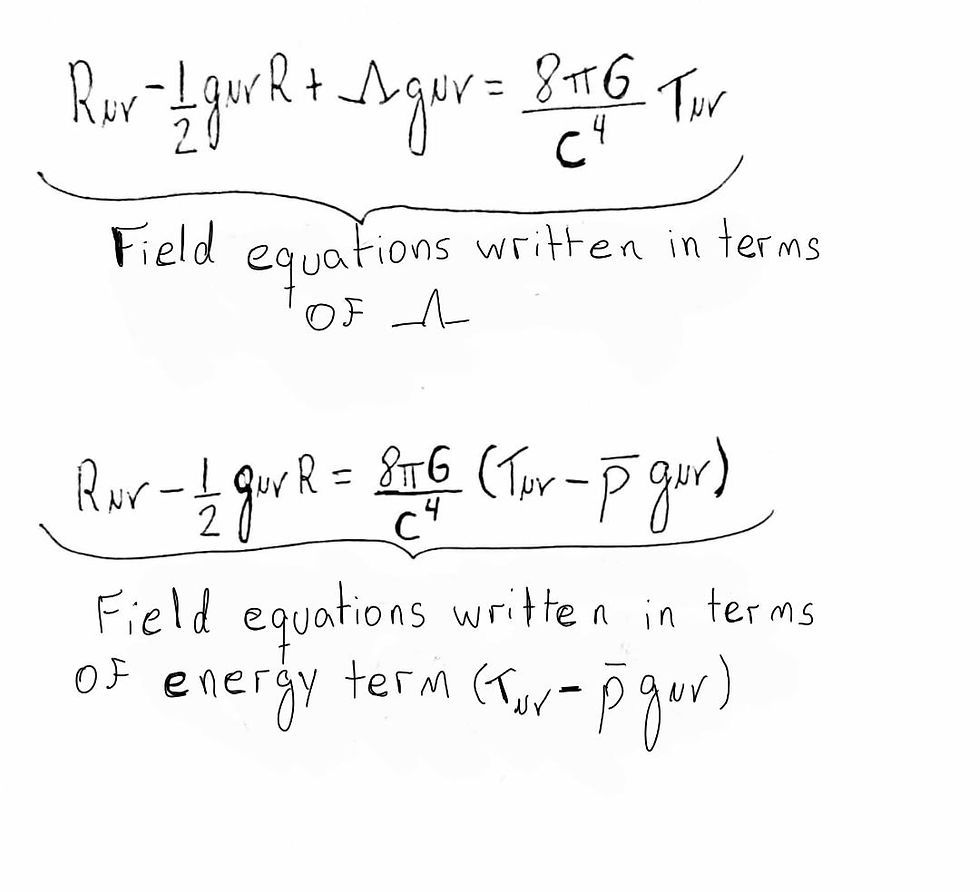
Photo 6
Summing up everything that has been said, the main point is: dark energy may be the same as the cosmological constant Λ, but it doesn't have to be.



Comments