


Quantum Chromodynamics (QCD)
- Pedro

- Sep 15, 2020
- 11 min read
It is widely recommended that the reader pay close attention to the names of the particles for a better understanding of the text.
*Notes:
Hadrons are particles composed of a bonded state of three quarks
In the Feynman diagrams represented here time takes place on the vertical axis
Nature has four fundamental forces: gravitational,
electromagnetic, nuclear weak, and nuclear strong. The forces were liststed from the weakest to the strongest. Each force has its respective "field theory" (there are reservations regarding gravity), in which particles, called gauge bosons, are responsible for mediating the forces of nature. In other words, the gauge bosons act as a "transport" for the forces of nature, "delivering" them to another class of particles, called fermions. Photo 2 illustrates the standard model, a type of "periodic table" of particle physics, presenting the fundamental particles (particles which cannot be subdivided), as well as the group to which they belong.
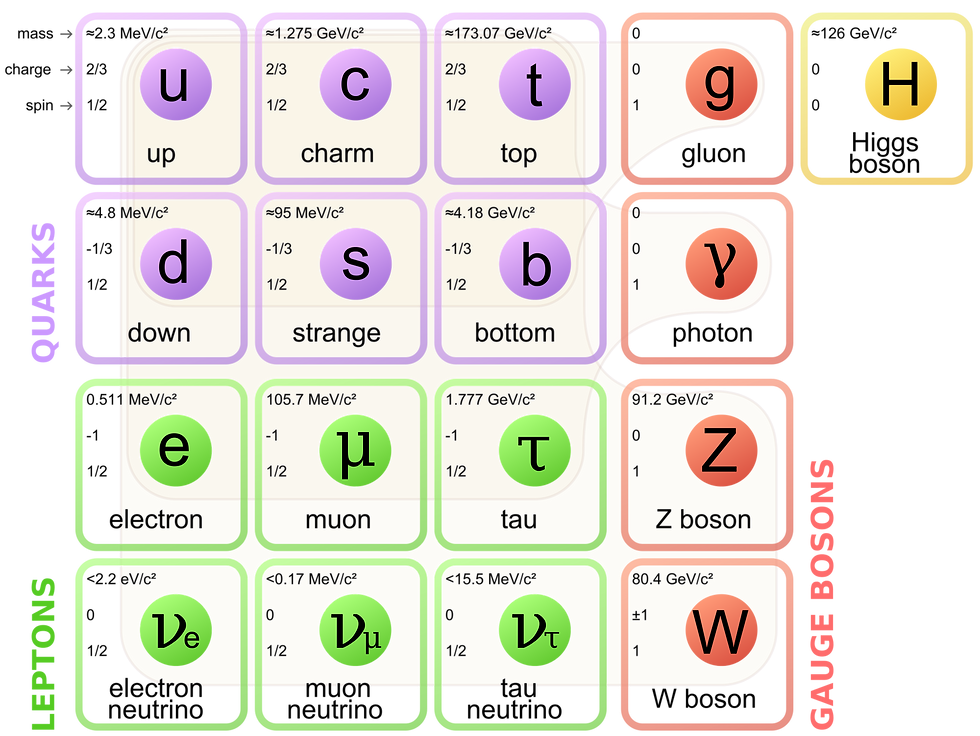
Photo 2
I have already wrote an article addressing the introduction to quantum field theory (QFT), as well as the presentation of quantum electrodynamics (QED), the quantum field theory responsible for explaining the electromagnetic force (basically the “quantum version” of classical electromagnetism). In this article we will explore another quantum field theory, focused on the description of the strong nuclear force: quantum chromodynamics (QCD).
To start off, it is valid to resume some principles of quantum electrodynamics, since it has some similarities with quantum chromodynamics. In QED, the particle responsible for intermediating the electromagnetic force is the photon. Two electrons, for example, undergo repulsion as they approach because a virtual photon is emitted from one electron and strikes the other. The emission of this photon alters the linear moment of both electrons, since the electron that emitted the photon suffered a "recoil" and the electron that received the photon suffered an "impact". This interaction is shown in photo 3, in one of the most recognized Feynman diagrams.
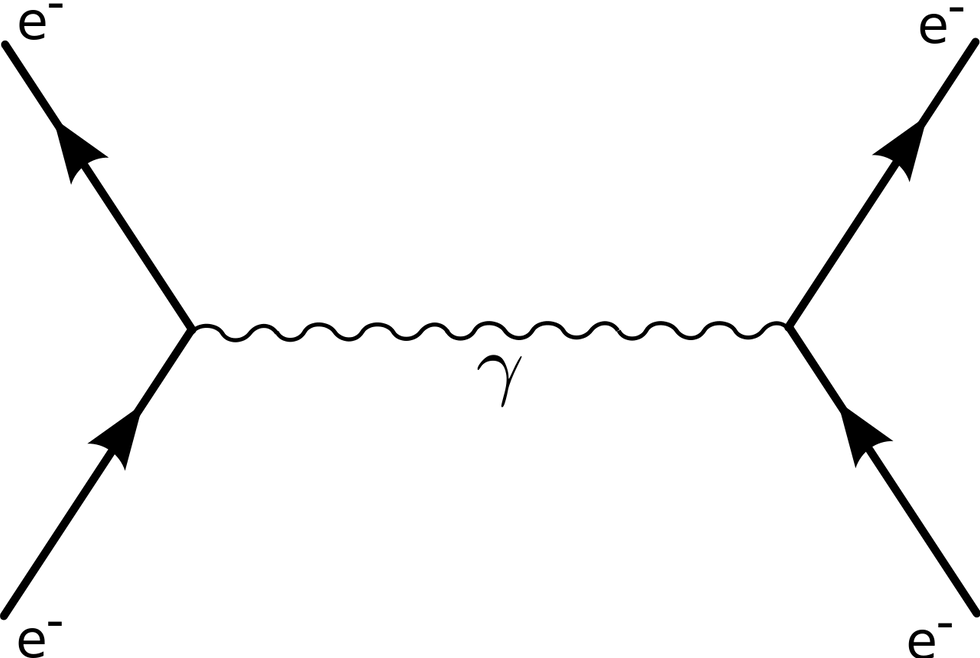
Photo 3
In 1964, scientists Murray Gell-Mann and George Zweig independently proposed that protons and neutrons may be formed by even smaller particles, the so-called quarks. In the 1970s, experiments carried out on SLAC (Stanford University's linear particle accelerator) confirmed the existence of quarks. As the years passed, more quarks were "discovered", totaling 6 "types". The "type" of quark is called "flavor". The quarks' flavors are: up, down, bottom, top, strange, and charm. Protons and neutrons are made of three quarks, the flavors of which are up and down. The proton has two quarks up and one quark down and the neutron has two quarks down and one quark up. The spin of the quarks is ½, but the masses and the electric charges vary according to the flavors. Quarks have a fractional electrical charge (not interger as the proton +1 or the electron -1). The up quarks have 2/3 electrical charge and the down quarks have -1/3 electrical charge. Thus, because the protons are composed of 2 quark up and 1 quark down, we have 2/3 + 2/3 -1/3 = 3/3 = + 1 and, for the neutron, made of 2 quarks down and a quark up, we have -1/3 - 1/3 + 2/3 = 0 (hence the zero charge of the neutron).
Subatomic particles which have 3 quarks, like the protons and neutrons mentioned, are called baryons. However, as seen in collision experiments carried out on particle accelerators, there are also particles composed of two quarks, these being called mesons. Photo 4 helps to “organize” the range of particles presented so far.
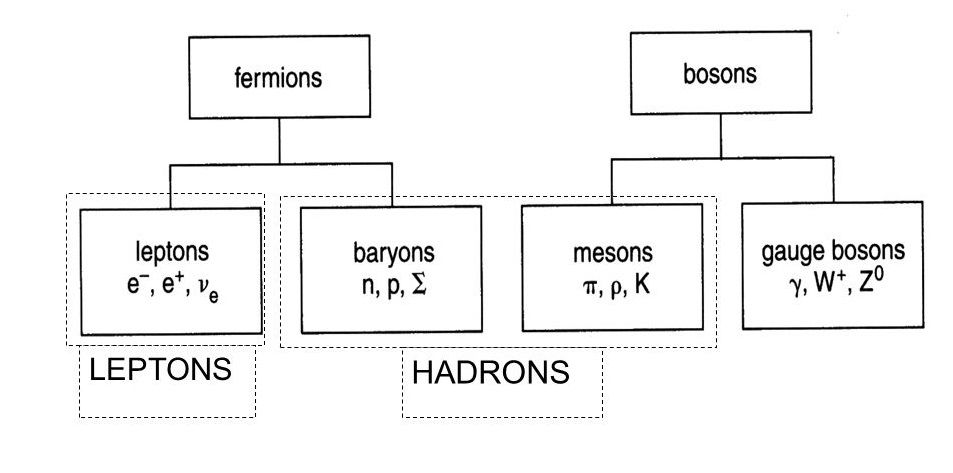
Photo 4
In the experiments, protons with increasing energies collided with atomic nuclei, which resulted in the generation of a series of new particles such as pions (represented by π), sigmas (represented by Σ), lambdas (represented by Λ), among others, proving that protons and neutrons are not fundamental particles.
In the same way as for the electromagnetic force, the strong nuclear force is also established by the exchange of particles. However, for quantum chromodynamics, the bosons responsible for the strength of the interaction are the so-called gluons (and not the photons as in QED). The name "strong nuclear force" is coherent since the strong nuclear force is about 100 times stronger than the electromagnetic force. Despite this, the “reach” of these respective forces are different. While the electromagnetic force is capable of being "efficient" even at distances greater than atomic radii, the strong nuclear force is no. The range of the strong nuclear force is extremely limited, acting at distances in the order of 1 femtometer (1 *10^ (- 15) meters). For distances greater than 2.5 femtometers, the strong nuclear force becomes insignificant. Thus, for the two forces considered, we have two distinct operating regimes; for greater distances the dominance is given to the electromagnetic force, while for small distances (approximately the distance between two particles in the atomic nucleus), the strong nuclear force is the dominant one. Photo 5 shows a graph comparing the "influence" of forces in different distance regimes (note that here we are dealing with the comparison between two protons, the smallest integer units of electrical charges (the electromagnetic force varies substantially depending on the electrical charges). Photo 6 shows the simultaneous action of the strong electromagnetic and nuclear forces on two protons (the fact that the electrical force between two particles of the same charge is repulsive is highlighted, as shown in photo 6).
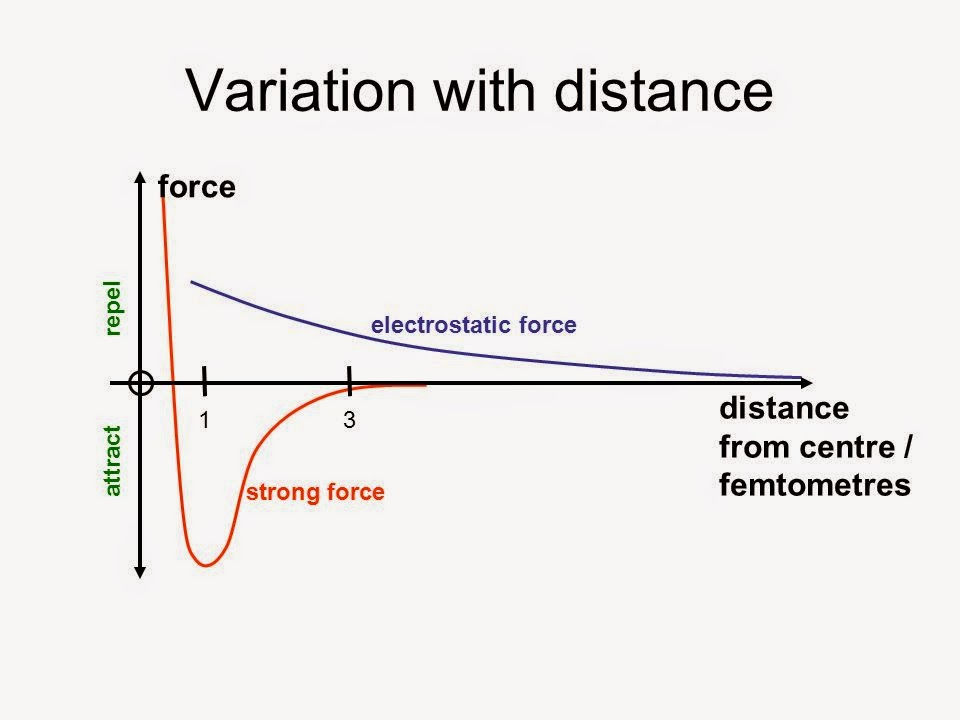
Photo 5
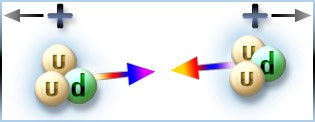
Photo 6
The “short-range” of the strong nuclear force explains the instability of very massive nuclei (with large numbers of particles), since the nuclear radius becomes too large for the “glue” of the strong nuclear force to be efficient. When the nuclear radius exceeds the "efficience surface" of the strong nuclear force, the electromagnetic force will start to predominate, resulting in radioactive processes (see photo 7). In particle physics, this fact is explained by the so-called "nuclear binding energy" which is basically how much energy is keeping the nucleus "glued". If we inserted an amount of energy corresponding to the binding energy of a certain element in its nucleus, a particle of the nucleus would be “ejected". The nuclear binding energy is given by E_b = (Z*m_proton + N*m_neutron-m_atomic)*c ^(2) (Z being the number of protons, N the number of neutrons and m_atomic the mass of the atom under consideration). Note that if we look closely, this formula is the famous E = mc^(2). Photo 8 shows a graph relating the binding energy per particle of the nucleus as a function of the nuclear mass. Also note that, in the graph, the maximum is found in iron, which has 56 particles in its core. For elements with larger nuclei, the strong nuclear force becomes inefficient (lowering the binding nuclear energy), making the elements unstable and increasing the chances of radiation.
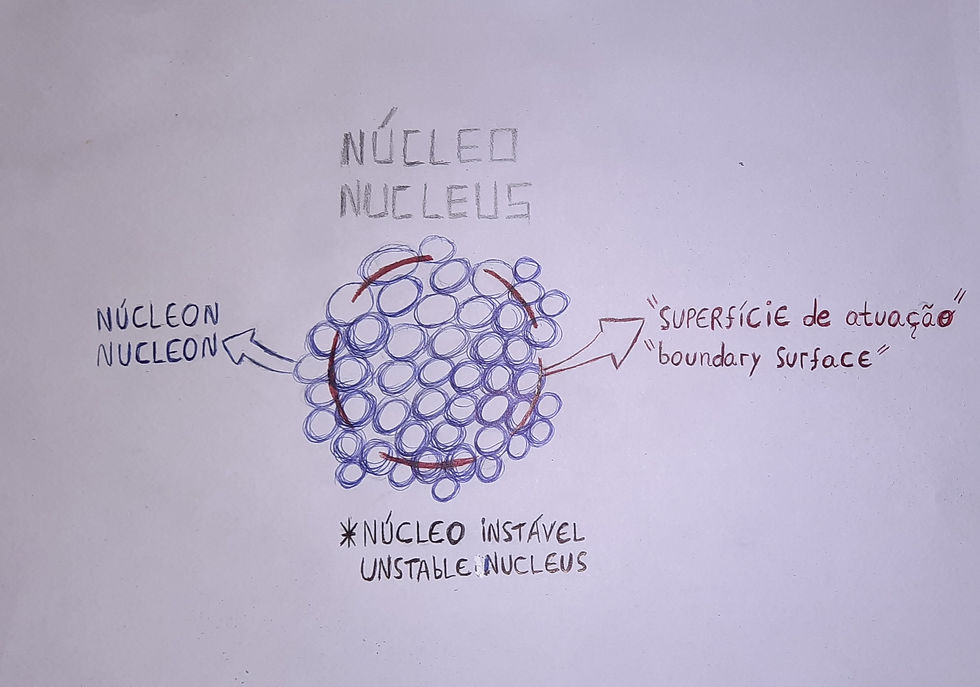
Photo 7
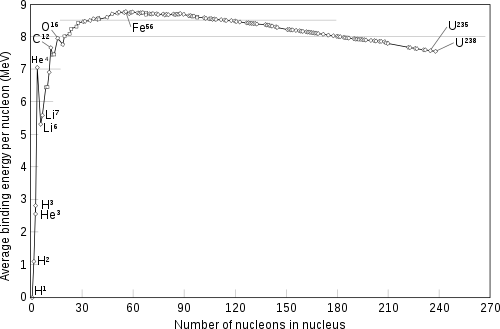
Photo 8
Other comparisons with quantum electrodynamics are appropriate for understanding quantum chromodynamics. In quantum electrodynamics, gauge bosons are, as mentioned, photons, which have no mass or electric charge. The same is true for the quantum chromodynamic gauge bosons, the gluons. The similarities between QED and QCD are such that even their respective Feynman diagrams are similar (see photo 9). However, there is a fundamental difference: gluons have a so-called "color charge," whereas photons do not.
* This difference means that gluons can interact with each other (one gluon "feels" the presence of the other), which does not happen in the case of photons because they do not have electrical charge or color charge (one photon is a "ghost" to the other).
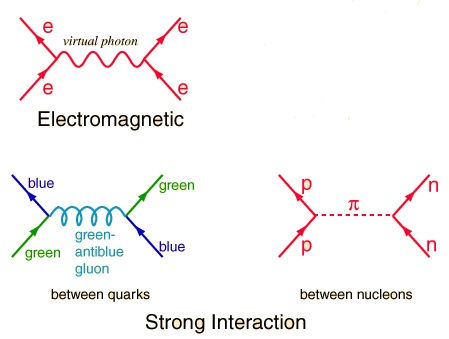
Photo 9
But what is the color charge? We know that electrons have electric charge -1e and protons + 1e ("e" being the elementary electric charge constant). The color charge is, like electrical charges, an intrinsic property of the particles that have it. The name "color charge" has no relation to the colors (optical perceptions) that we are used to; such designation was criticized by physicist Richard Feynman because of the potential for confusion. The nomenclature is due to an experiment carried out by James Clark Maxwell. In the experiment, the colors green, blue, and red were combined, resulting in white. Quarks within hadrons are "bounded" by gluons (hence the term "bound state"). Gluons, as mentioned, have a color charge, and they can “carry” the colors green, red, and blue from one quark to another, those being absorbed and emitted. The exchange of gluons establishes the nuclear force within the nucleons (particles of the atomic nucleus, i.e. protons and neutrons). When “exchanging” gluons, the quarks have their colors changed according to the absorption/emission considered. The "combination" of the charges of blue, green and red color, as occurs in protons and neutrons, result in a zero color charge (in a similar way to the white in Maxwell's experiment) and, therefore, hadrons have zero color charge. However, it is noteworthy that the constituents of hadrons, quarks, do have a color charge (in other words, the parts have color charge but the compound does not). Photo 9 illustrates the exchange of gluons between quarks in a baryon.
Similar to electrons, quarks also have their antiparticles, each with its corresponding "anti-color", that is, "anti-red", "anti-blue" and "anti-green". The combination of a quark with an antiquark occurs in mesons, for instance. The quarks in a meson combine to result in a neutral color charge.
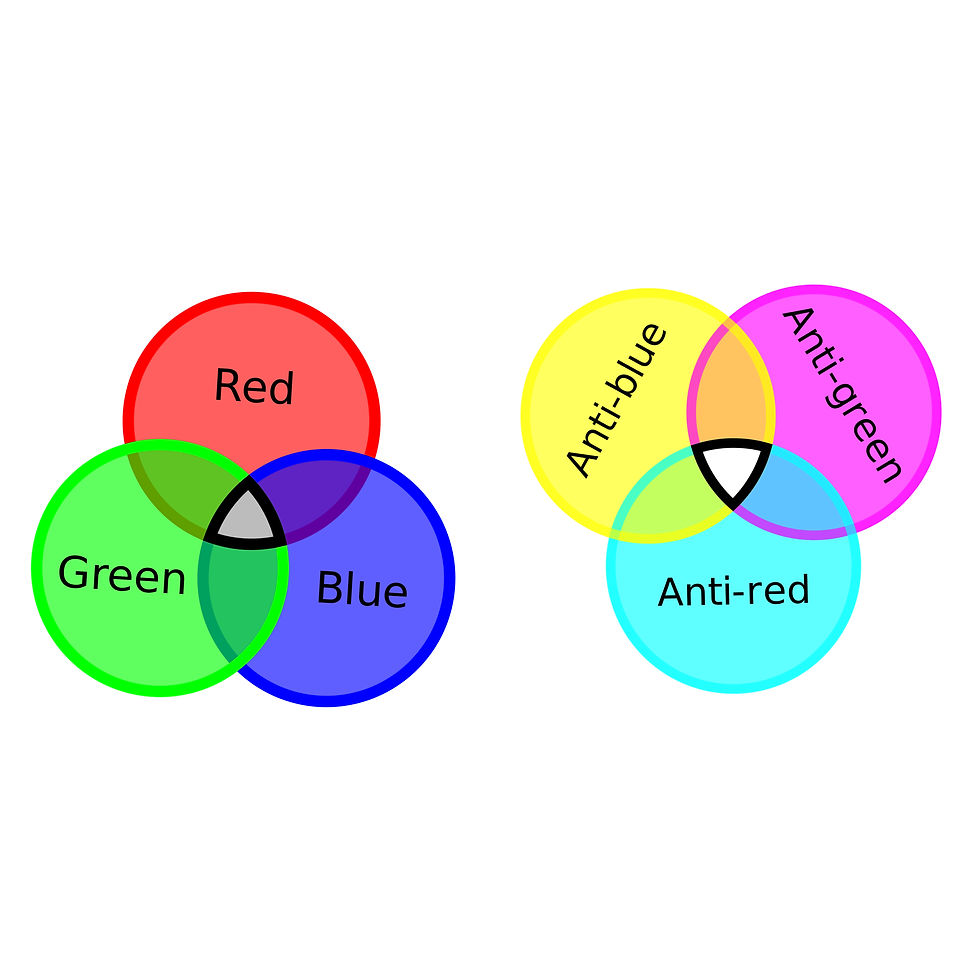
Photo 10
Now that we understand, to some degree, what color charge is about, it is important to recognize its origin. About a month after the quarks' model was proposed, a different particle was detected. That particle has three quarks of the "strange" flavor. There is a fundamental principle in quantum mechanics, called the "Pauli's exclusion principle", which states that two (or more) fermions cannot occupy the same quantum state simultaneously. This means that there must be at least one factor that can distinguish the "configuration" between two or more fermions. For two equal quarks, the spin factor is sufficient for the distinction, since the spin of one must be the opposite of the other. However, in a system with 3 equal strange quarks, the spin is no longer sufficient. Therefore, it was concluded that there should be another factor that could offer the distinction so that the exclusion principle is not violated. This was, precisely, the color charge.
The strong nuclear force has another aspect distinct from other forces of nature. As counterintuitive as it may seem, it increases with distance. The attempt to separate quarks causes the nuclear force to increase, analogously to the strength of an elastic band, which increases the more stretched the elastic is. Consider the quarks of a proton. As we "stretch" one of the quarks, in an attempt to separate it from the others, more and more energy is "installed" in the connection of this quark with the rest of the proton, making it stronger. However, there is a point at which the connection of the quark that we want to separate breaks (similarly the elastic bursts), what happens next? The energy previously stored in the “elastic” holding our quark is converted into a (new) antiquark, following the mass-energy equivalence, so that the “escaped” quark forms a new bound-state with the generated antiquark. The fact that quarks can never be alone (they are always in bounded states) is a principle of quantum chromodynamics called "confinement". The continuous rupture of the connections between the quarks generates new pairs of quark-antiquark, which can have their connections broken, creating new pairs, and so on. The result is a bundle of quarks traveling in approximately the same direction as the first that was “stretched” from the nucleus, as shown by the CMS experiment in photo 11.
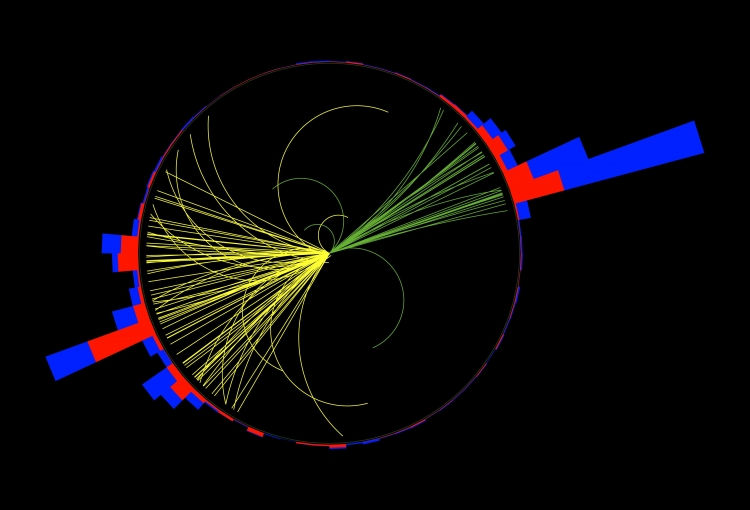
Photo 11
We will now turn our attention to the Feynman diagrams which describe the exchange of gluons between quarks. Basically, we will discuss the "physical view" of the process that guarantees the stability of the nucleons (protons and neutrons). See photo 12. In it we observe the interaction between two quarks, an up and a down. In the left portion of the diagram, we can see that the quark up, which initially has a red color charge, emits a gluon, changing its color charge to green. In the middle portion of the diagram we can see the exchange of the gluon itself (represented by the spiral). In the right part of the diagram we can see that the quark down, which initially had a green charge, absorbs the gluon emitted by the quark up, changing its color charge to red. The gluon that was emitted is an anti-red green gluon. We can understand the effect of this gluon as if it had “inverted” the colors of the quarks (“removed” the red from the quark up, giving it to the quark down, and “removed” the green from the quark down, giving it to the quark up). Once again, it is emphasized: the exchange of gluons provides the "glue" that "sticks" the quarks, establishing the connected state (note the quotes, in reality the quarks are not "touching" each other).
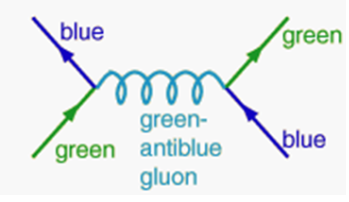
Photo 12
So far we have described how quarks remain stable and cohesive within nucleons, but what about nucleons themselves? How are protons not repelled by the electromagnetic force? The role of the strong nuclear force described in the previous paragraphes does not provide the answer to these questions, since the action of the gluons previously described is "local," and does not involve the other particles in the atomic nucleus. It turns out that, among nucleons, mesons (more specifically the particles of the pion category), are constantly emitted and absorbed by protons and neutrons. The exchange of pions for nucleons generates the strong nuclear force, which is attractive to the radius of action considered, easily overcoming the electromagnetic force (which, in this case, is repulsive).
Pions have three varieties, depending on the electrical charge they have. The “dynamics” of the exchange varies according to the considered pion. The π^(+1) pion has a +1 electric charge, the π^(0) has a neutral electric charge, and the π^(-1) pion has a -1 electric charge. Photo 13 shows Feynman's diagrams for all the three pions, with the appropriate descriptions. Also note that the force “felt” by the nucleons, due to the exchange of pions, is approximately the same (i.e the strong forces between two protons, two neutrons and/or a proton and a neutron are practically equal).
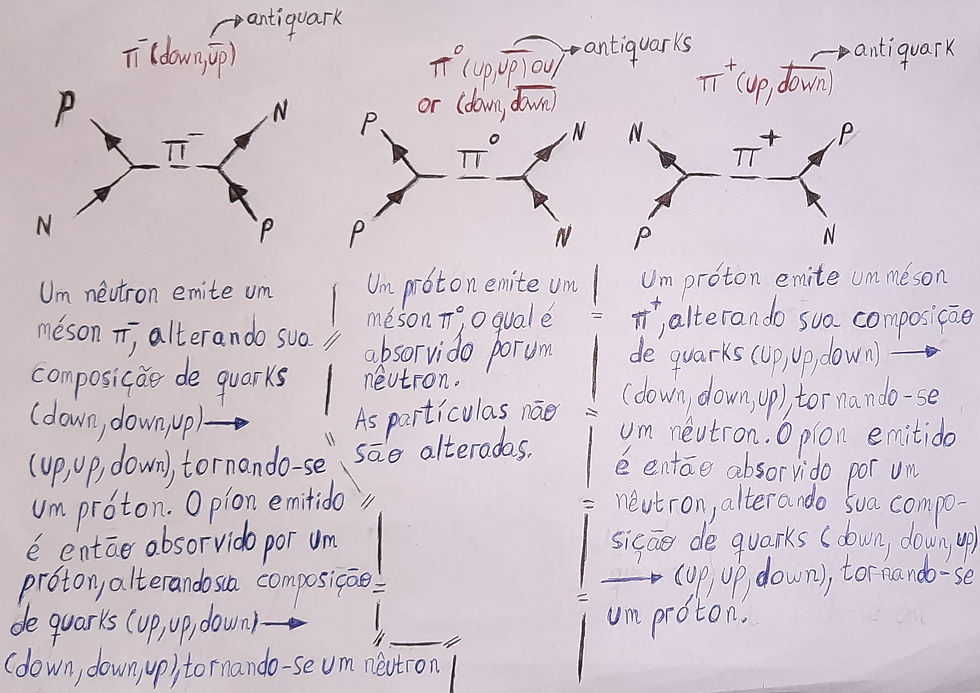
Foto 13
Another very important principle of the QCD is the so-called “asymptotic freedom”. Briefly, the bound states are "stronger" when the energy of the system is less (with the particles more distant from each other), and "weaker" when the energy of the system is greater (with the particles closer to each other). The closer the particles are, the more the free particle behavior is resembled (the bound state is "weakened," following the ellastic analogy). Photo 14 shows a graph of a quark and an antiquark. Note that the energy grows from left to right (on the horizontal axis) and the distance between the particles decreases from left to right. The coupling constant (on the vertical axis) basically measures the "strength" of the interaction between the particles (in other words, the intensity of the bound state).
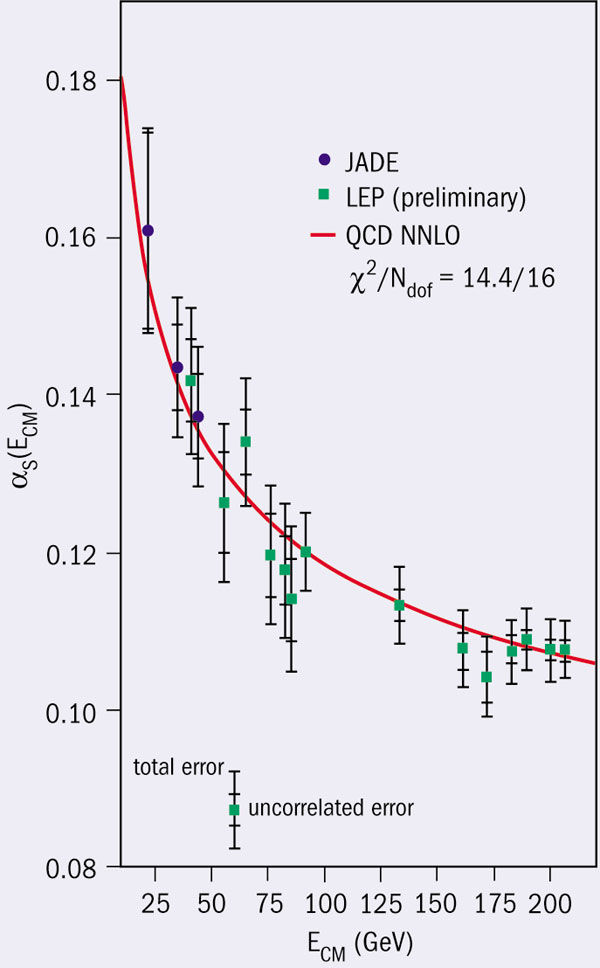
Photo 14
*The vertical bars found on the curve show the experimental uncertainties.
The strong nuclear force also plays an important role in the formation of stars. When protostars (“embryonic stars”) reach a temperature around 10 million degrees Kelvin in their nuclei, hydrogen atoms acquire sufficient energy (and therefore speed) so that the constant hydrogen-hydrogen collisions bring atomic nuclei closer together sufficiently for the strong nuclear force to start to act, uniting the two hydrogen nuclei, thus forming a helium nucleus, according to the chemical equation H + H → He + energy. For higher nuclear fusions, that is, for heavier elements, the role of the strong interaction is preserved. In this sense, the strong nuclear force plays a fundamental part in the process of nuclear fusion and, therefore, in the creation of chemical elements in the grandiose “cosmic furnaces” (stars).
Finally, this article will address a peculiar state of matter, called "quark-gluon plasma" (yes, the one from the show "The Big Bang Theory"). Unlike the “conventional” physical states of matter (solid, liquid, and gas), which are determined according to the energy state of the atoms, the quarks and gluons plasma is prospected exclusively by quarks and gluons. This stage of quantum chromodynamics is found only in extreme situations, as in the universe within the first second post Big Bang. The temperature required for matter to enter this state is so high that it detaches electrons from atoms (makes them free) and basically "melts" the protons and neutrons of atomic nuclei, leaving only the constituent particles of these (quarks and gluons).
Note: Electrons that have been detached from atoms are present in the quark-gluon plasma, but have no interaction (they are negligible).
With quantum chromodynamics and electroweak theory (the union of weak electromagnetic and nuclear interactions), we are able to understand reasonably well how the “small universe” works. Perhaps one day a "theory of everything", which in principle brings the union of all the forces of nature, will be validated, inviting us to know the most profound secrets of the cosmos.
Reference material:
Physics for scientists and engineers (volume III by Paul A. Tipler and Gene Mosca)
Origins (Neil deGrasse Tyson)
Death by Black Hole (Neil deGrasse Tyson)
Astrophysics for People in a Hurry (Neil deGrasse Tyson)
QED: The Strange Theory of Light and Matter (Richard Feynman)
The Quantum Universo (Brian Cox and Flavio Demberg)
50 Physics Ideas You Really Need to Know (Joanne Baker)



Comments