


Nebulae (unique version)
- Pedro

- Mar 2, 2019
- 3 min read
Updated: Jun 17, 2020
Nebulas
It is agreed that nebulas are of the most beautiful objects the universe has to show off. They have a very simple definition: giant matter clouds. They are also responsible for the creation of stars and planetary systems. Nebulas are known as “the nursery of the stars”. Nebulas are mostly made of hydrogen helium and plasma; they aren’t dense, but are giant, in general having a diameter of hundreds of light-years. Nebulas mark the “birth” and “death” of stars.
In the year of 1755 the philosopher Immanuel Kent proposed our Sun and its planets were formed simultaneously, during the process of the collapse of a gas and dust cloud (nebula); later on, in 1796, Pierre Simon Laplace, important mathematician, astronomer and physicist, developed Kent’s idea, in what turned to become the nebular hypothesis.
There is a classification for nebulas, which is composed of: emission nebula, reflection nebulas, dark nebulas and planetary nebulas.
Emission nebulas have high temperatures and shine thankfully to the radiation received from the neighbor stars; the radiation is absorbed by the atoms which eventually release that energy in form of light. Due to the fact that hydrogen is the principal component of nebulas, great fraction of those have red in its color (because of the emission spectrum of hydrogen). Scientists can so determinate the chemistry elements of the nebulas just by studying the colors of the star makers.
Reflection nebulas don’t emit light by themselves, they simply reflect the light of the near stars. In general, they are mostly blue (because blue light spreads more easily: same reason for our sky to be blue).
Dark nebulas don’t let most of the light pass through it, and so are identified by the contrast with the sky around it.
Planetary nebulas are named that way because when the astronomer William Herschel first observed one of these, he thought it was a planet. Planetary nebulas are formed from a central star, which, in an advanced stage of the star cycle, more specifically in the asymptotic giant branch (final moments of a red giant) ejects its outer layers because of the generation of strong stellar winds and pulsations, leaving as a remnant, in most cases, a white dwarf; the intense radiation from the star the ionizes the expelled layers (which is the nebula itself) and makes it shine in the various spectrum colors (corresponding to the present elements). Sun will go through that process, bringing to life a marvelous planetary nebula.
A very interesting case is related to the Pillars of creation, columns of gas and dust with 4 light years of extension, located in the Eagle Nebula, seven thousand light years from Earth. In case you point a powerful enough telescope in the right direction in the sky you will see the Pillars of Creation, but not really; what you see in fact is the past, in an epoch such structure still existed. The pillars were supposedly hit (the "supposedly" will be explained) by a supernova six thousand years ago. However, the light of the Pillars of creation takes seven thousand years to reach us, and that means that the supernova will only hit that one structure, in our perspective, in a thousand years. The "supposedly" mentioned refers to the fact that a few scientists believe that the evidences about the existence of that supernova don't hold, that is, the Pillars of Creation were not destroyed.
However, we state: looking at the sky is facing the past. Our observations have a delay dictated by the time the light takes to reach us on Earth.
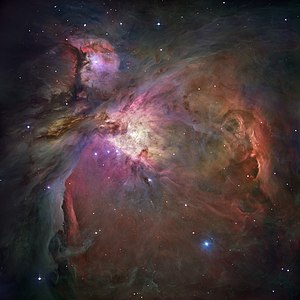
The images below are, respectively: Helix nebula, Pillars of Creation, Crab Nebula and Orion Nebula
Reference material: 50 astronomy ideas you really need to know/
https://en.wikipedia.org/wiki/Nebula





Comments