


Measures in astronomy, cosmic perspective and address
- Pedro

- Feb 22, 2020
- 3 min read
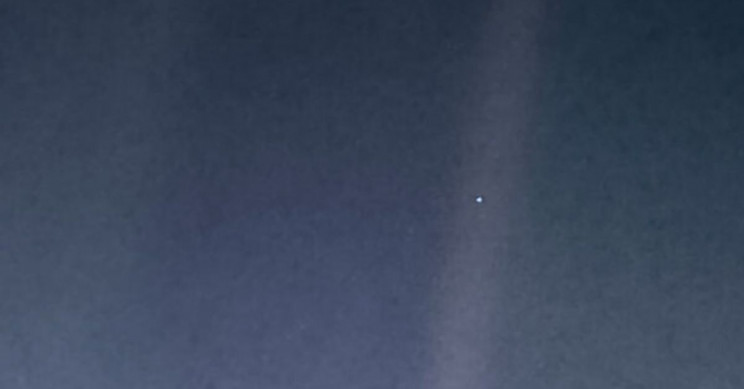
"Pale blue dot." This is how the great scientist, Carl Sagan, described Earth in a photo taken by the Voyager I space probe, at a distance of six billion kilometers.
In everyday life, when we talk about astronomy, the recurring idea that comes to mind is that of the solar system, with its 8 planets and the Sun.
A few centuries ago, we had the geocentric model in mind, which placed the Earth as the "center of the Universe", with the moon, the Sun and other stars orbiting it. With the coming of Copernicus and Galileo, our planet lost its "exclusivity" so that we began to have a better understanding of the immensity in which we are inserted.
It is important to have a notion of our "cosmic address", which places us in the universe. Imagine that you are filling out a form for receiving an order, in which you will need to explain the location of your home. Earth, is, in our analogy, your home, thus being the first line of our cosmic address. The radius of the Earth is approximately 4,400 miles. The second line of our address is the Solar System, being the equivalent of the street on which you reside. The radius of the Solar system, considering Neptune's aphelion (longest distance from the orbit of a planet from the Sun), For the third line of our address, we have the neighborhood, which corresponds to our galaxy, the Milky Way, whose radius is around 500,000,000,000,000,000,000,000,000 km. Its city, along with other neighbors, would constitute, in our analogy, the so-called "local group", which is a set of more than 54 galaxies, relatively close to each other, most of them are dwarf galaxies (also called satellite galaxies). The two main galaxies in the local group are the Andromeda and the Milky Way, which will collide over the next 4 billion years. The radius of the local group is approximately 50.000.000.000.000.000 km. Advancing further, we have the fifth line of our cosmic address, the supercluster of Virgo, equivalent to its state. Virgo's supercluster has a radius of 500,000,000,000,000,000,000 km. On this scale, points alike the ones we see on the night sky here on Earth start representing entire galaxies, each containing millions or even billions of stars. However, the virgin supercluster is only one of the estimated 10 million superclusters, which make up the next line of our cosmic address: the observable universe. In simple terms, the observable universe is the frontier on which we can see. The universe is 13.7 billion years old and, because the speed of light is finite, we cannot glimpse distances beyond 130,000,000,000,000,000,000,000,000 km, simply because the light of such regions did not have the time, in the entire history of the universe, to reach us. But don't get confused! The observable universe is not a physical barrier, but rather a "visual boundary". In our analogy, the fifth (and last) cosmic address is the national location (country).
With the knowledge of our place in the universe, we can begin to clearly see the spatial magnitude of this universe. In the description given previously, as we evolved in scale, the distances involved grew more and more, so much that the use of kilometers units became unadvantageous. Thus, the need for the use of new units of measures becomes a need. In astronomy and astrophysics, the units used for distances are:
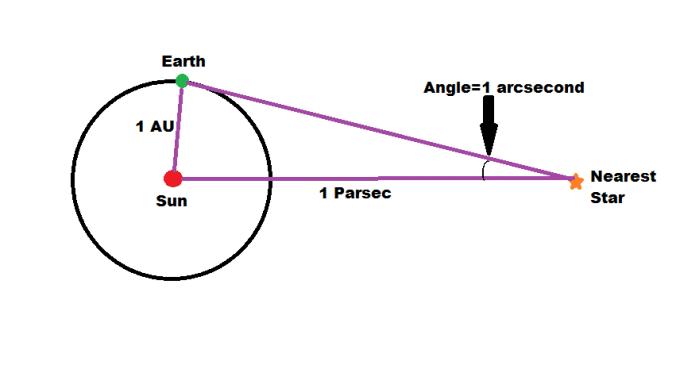
Astronomical unit (u.a): distance between the Earth and the Sun. 1u.a=149,600,000 km light-year: distance that light travels in a period of one year. 1 light-year =63,241 u.a parsec: is defined based on triangles, as shown in photo 2. 1 parsec=3.26 light-years (approx.)
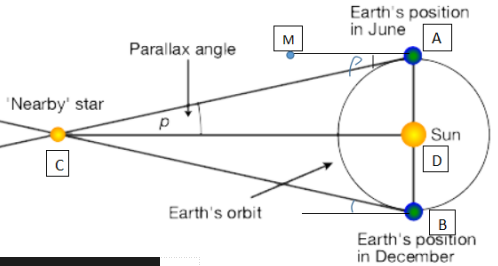
The estimation of distances is one of the greatest difficulties encountered in astronomy. Although it may seem trivial, measuring colossal distances, whether from distant stars or galaxies, can be an extremely complex task. There are techniques and approximations that are used for estimates, which vary according to the magnitude of the distance involved. The only direct way to measure distances in astronomy/astrophysics is through the use of stellar parallax. Stellar parallax is measured from the Earth's orbit around the Sun. If we set two distinct points of orbit (A and B, as shown in photo 3), there will be a difference in the apparent position of the observed object. We can then, with simple trigonometry, calculate the distance to such an object. However, the simplicity offered by the use of stellar parallax is limited, and the method is efficient for distances less than 1kpc (kilo-parsec). For greater distances, non-direct methods have to be applied, with the use of HR diagrams, study of cefeida variable brightness stars, supernovae and Hubble's law.
Photo 1: “Pale blue dot" (photo taken by space probe Voyager I)
Photo 2: Definition of parsec
photo 3: Stellar parallax
Reference material:
Cosmos: A Spacetime Odyssey (2014)
50 Astronomy Ideas You Really Need to Know (Giles Sparrow)
The evolving universe (S. George Djorgovski)






Comments