


Heisenberg uncertainty principle
- Pedro

- May 23, 2020
- 6 min read
Heisenberg's uncertainty principle is one of the pillars of quantum mechanics. It is because of him that much of the peculiar and unique phenomena of the quantum world happen. One of the aspects that lies at the heart of the uncertainty principle is the probabilistic aspect of quantum mechanics, whose incidence deeply troubled Einstein and challenged determinism (philosophy that stated everything in the universe could be precisely predicted).
In 1926, the young Werner Heisenberg was mad at Erwin Schrödinger, because on that year, Schrödinger, with the publication of his formulation of quantum mechanics (with the famous Schrödinger equation), had "stolen" the attention of the scientific community, which was previously channeled into Heisenberg's matrix mechanics (although the two approaches are equivalent).
After the two formulations were established, quantum science had a rapid evolution, with the involvement of scientists such as Paul Dirac and Pascual Jordan. In 1927 Heisenberg was poring over what had been established in quantum mechanics. It was during this period that the physicist noticed that particles on the atomic scale keep secrets inaccessible.
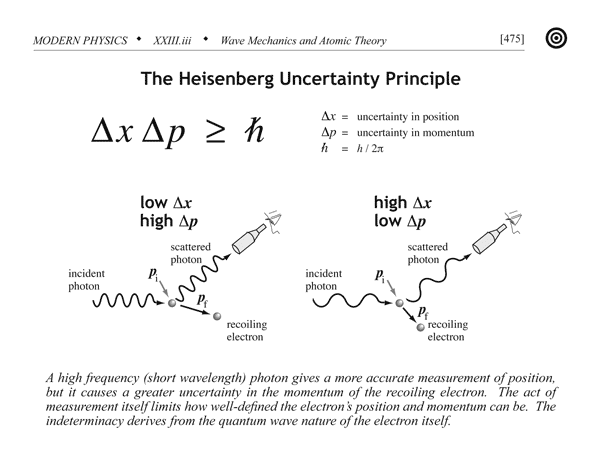
For the beginning of the discussion of the uncertainty principle it is important to understand that in order to observe a particle, such as an electron, the act of measurement will disturb the state of the electron. In order to detect the particle, it is necessary to hit it with some kind of radiation, such as photons, for example. Upon reaching the electron, photons transfer their linear momentum so they act as a "bullet", impacting the electron. The system is then changed from its initial state only by the mere act of measurement. There is, however, an apparent way to minimize the effect of the disturbance: using photons with longer wavelengths which, as observed in the equations p=h/λ and E=p*c, have lower energy and, therefore, alter less the state of the electron . However, when using longer wavelengths, the accuracy of measuring the electron position will be decreased, as shown in photo 2. This is the so-called "observer effect". However, the uncertainty principle is not all about to such effect, it has far deeper implications.
It is natural to ask whether there is any way to perfect an experiment so that there is no significant change in the initial state of the electron and that the measurement of the position of the electron is not compromised. Unfortunately not. There seems to be a fundamental limit to how deep we can understand the structure of the universe. Thus, we can see the consequence of the general statement of Heisenberg's uncertainty principle: it is not possible to develop an experiment in which both the position and the linear moment of a particle is measured with arbitrary precision, there will always be a relationship of uncertainty associated with these two quantities.
The uncertainty principle is more fundamental than one might think. The fact that quantities such as moment and position cannot be known simultaneously does not occur due to the inexperience of the experimentalist, nor by the lack of a more creative experiment. It's an inherent aspect of nature. To illustrate, let's consider the following experiment: imagine a slit, an electron emitter, and a wall behind the slit. We start the experiment with the size of the slit being a few times larger than that of the electron. As the electrons pass through the slit, they reach the wall as the square of their wave function indicates (the point on the wall right in front of the slit is the place most likely for the electrons to hit). If the size of the slit is then gradually decreased, the distribution of electrons in the wall will, surprisingly, start to spread (rather than get narrower, as you would intuitively expect). What happens is that as we decrease the size of the slit, we decrease the uncertainty of the position (we get more information about the particle's position) and, consequently, we increase the uncertainty of the particle's linear moment. In this way, the particle may change direction, given the increased uncertainty of its velocity, since the linear moment is defined as p =mv . It was concluded that even without the interaction with the particle (no radiation hit the electrons), the uncertainty principle remained. We reinforce the idea: Heisenberg's uncertainty principle is a fundamental property of nature and exists regardless of the act of measurement.
For a better visualization of the uncertainty principle let us consider some wave functions (function that describes the state of the particle). A spread wave function (such as of the form ψ(x)=Acos(kx)+Bsin(kx)) will present an arbitrarily large uncertainty in its position, but a precisely defined moment, since the wavelength is known and the relation of Louis de Broglie states that p=h/λ. If we had a wave function similar to the Dirac's delta (whose shape is defined only at one point, being null throughout the rest) it would have an arbitrarily small uncertainty in the position, but its momentum would be unknown (given the absence of wavelength). There is, however, a more palpable form of the wave function, with a greater physical sense, the so-called the "wave packet". A wave packet is a superposition of several waves of the shape ψ(x)=Acos(kx)+Bsin(kx) with different values of k (wave vector module), so that the interference (addition) of these waves cancel out at certain points and are reinforced in others (there is both constructive and destructive interference) in order to generate a single new wave which is spread in a limited region of space; it has some finite uncertainty in its position and also a finite uncertainty in its momentum (since its wavelength is not precisely known). The representation of the three wave functions mentioned is in photo 3.
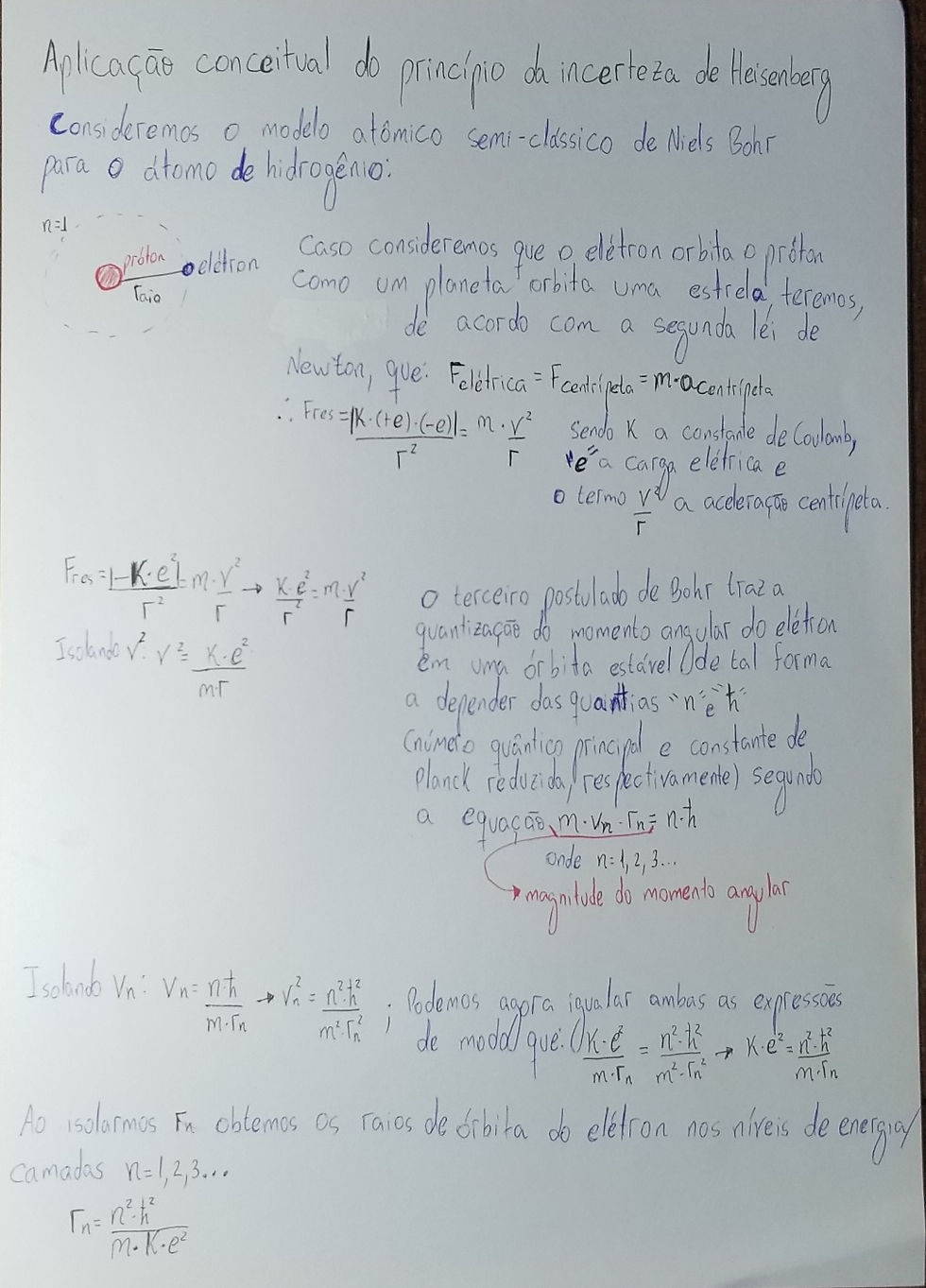
Mathematically, the uncertainty principle is defined by the " ∆x∆p_x≥ℏ/2", where ∆x is the position's uncertainty, ∆p_x is the momentum's uncertainty and ℏ is the redyced Planck constant, whose value is h/2. The above relation is explored in photos 4, 5 and 6.
There are further implications of the uncertainty principle. The momentum and position are not the only quantities that possess a relationship of uncertainty. Energy and time also present such a relationship, in a way that the more precisely we know the measured energy, the less precisely we will know the time elapsed during the measurement act (and vice versa). One of the main consequences of this relationship is quantum vacuum fluctuations. According to the uncertainty principle no system, not even vacuum, can have energy absolutely equal to zero. There's always an uncertainty in energy. This implies that, for short periods of time, pairs of particles, called "virtual particles" can come into existence and, after a while, annihilate each other (obeying, in the long run, the principle of energy conservation). In short, uncertainty is able to create particles spontaneously. This phenomenon is responsible for the Casimir effect (already discussed on the page) and also for Hawking radiation. Mathematically the relationship is defined by ∆E∆t≥ℏ/2.
*Note: more formally, in quantum field theory, when quantizing the electromagnetic field, we see that the particleless state (vacuum) has a non-null amplitude, as expected by the uncertainty relationship between energy and time.
Finally, it is important to highlight the way in which the uncertainty principle is taken in the literature of quantum mechanics. More rigorously, we define relationships of uncertainty as operators that do not commute, that is, the commutator between the considered operators is non-zero (there is rest of commutation). For example, for the case between the momentum and position, we have that [x, p_x]=x*p_x-p_x*x=iℏ
(note that we chose to omit the operator identity I in the relationship presented). The commutator presented is one of the canonical commutation relationships. Furthermore, the commutating properties of quantum (and their respective relations of uncertainty) govern various principles and behaviors of quantum, such as orbital angular momentum.
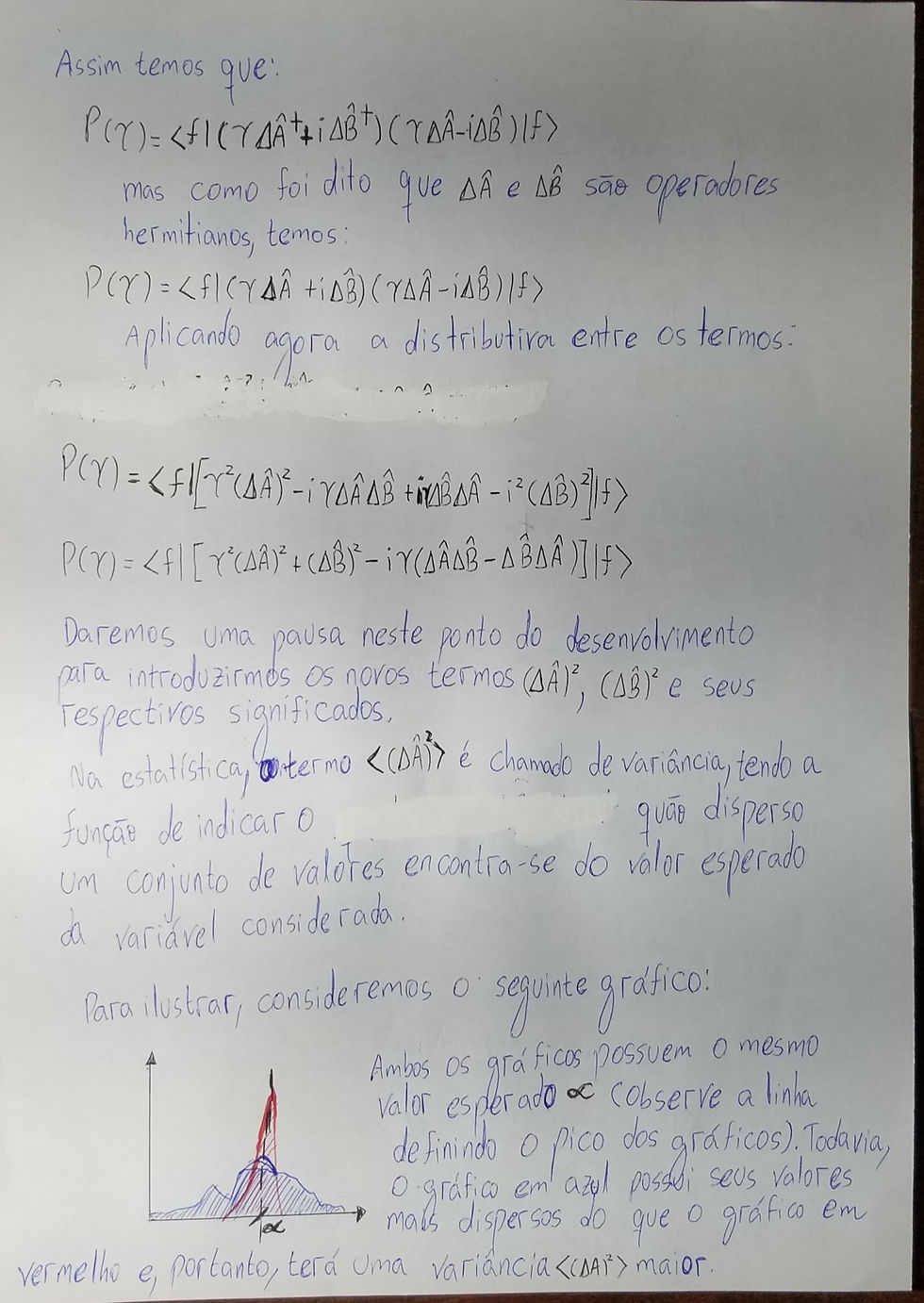
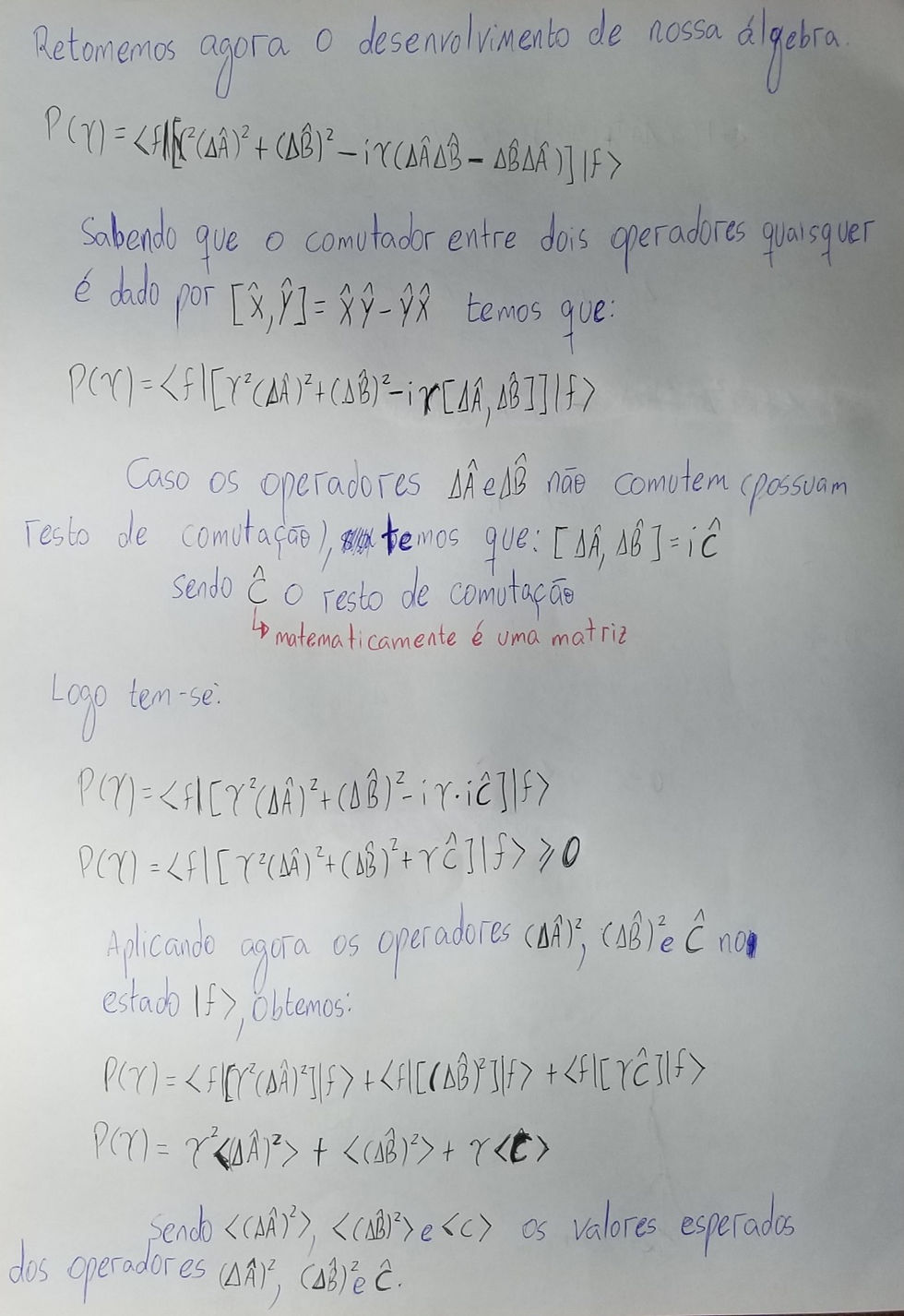
The mathematical demonstration of the uncertainty principle is found in photos 7, 8, 9, 10 and 11, and was based on the excellent material of Professor David A.B. Miller of Stanford University.
Photo 1: Werner Heisenberg
Photo 2: effects of radiation on the electron
Photo 3: some wave functions and their relationship to the uncertainty principle (photo obtained from the app "Quantum")
Photos 4, 5 and 6: application of the uncertainty principle in the Bohr atomic model Photos 7, 8, 9, 10 and 11: mathematical demonstration of the uncertainty principle









Comments