


Hawking radiation in Black Holes
- Pedro

- Jun 11, 2020
- 8 min read
Updated: May 19, 2021
The so-called Hawking radiation, proposed by English physicist Stephen Hawking in 1975, proposes an unlikely combination: relativity and quantum mechanics. Hawking surmised that in the vicinity of a black hole, whose dominant theory is general relativity, subatomic particles, governed by the laws of quantum theory, would have an effect on the black hole, in a way they reduce its mass, causing it, over time, to disappear. Such effect became known as "evaporation". Although Hawking radiation can be developed theoretically, the physical description (i.e., the actual process) itself is not very well understood. Two versions will be discussed here, a simpler and more intuitive (with mathematical description) and the other given by Stephen Hawking himself. However, although the explanations of the physical phenomenona are not identical, the results provided are the same.
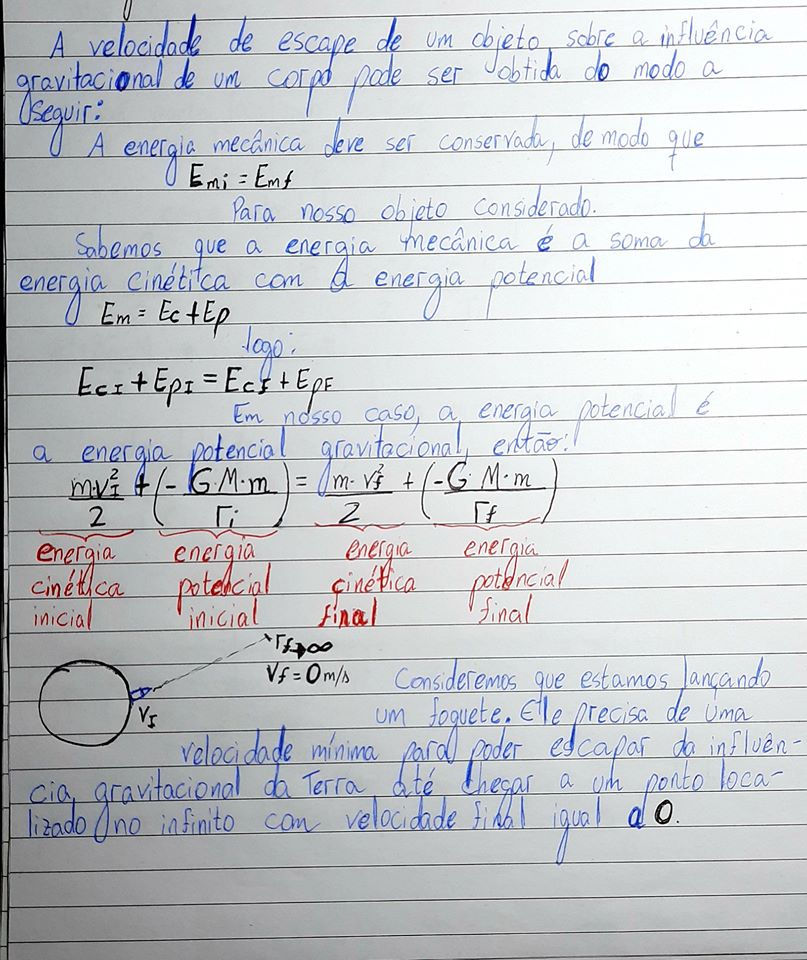
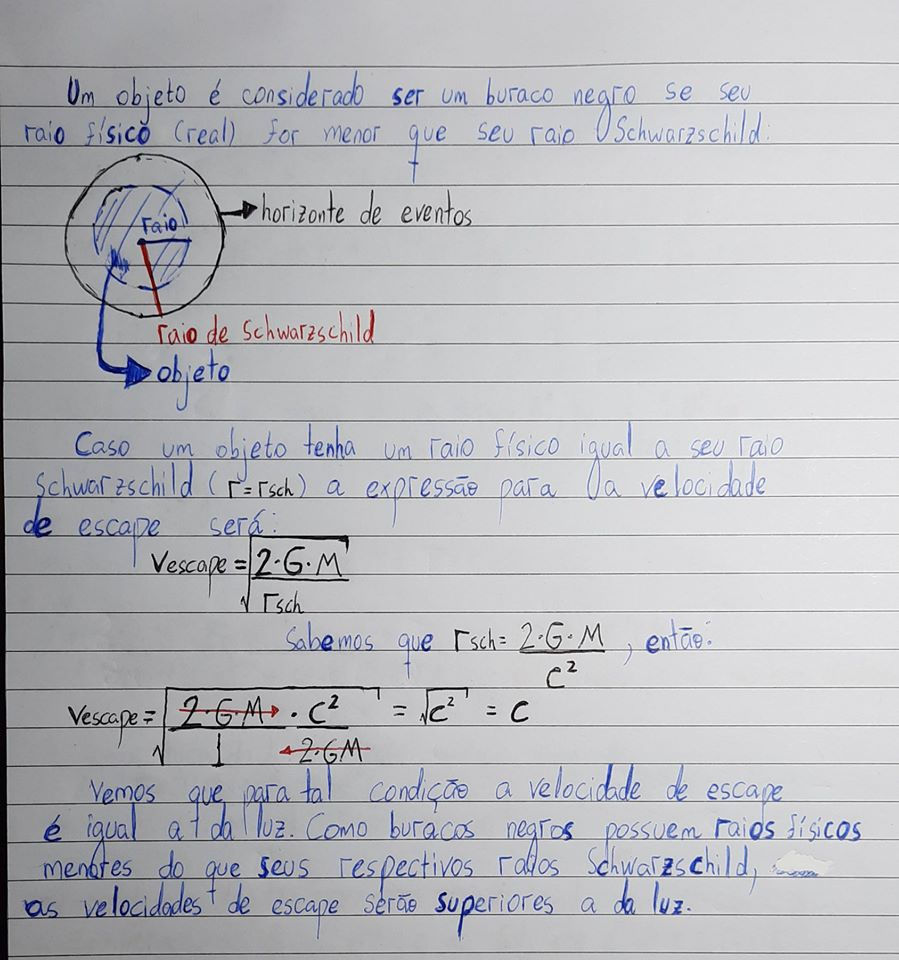
As described in previous chapters, black holes are composed of a singularity (a point of infinite density in which the laws of science currently fail) and have event horizons, these being located at a certain distance from the singularity, given by the schwarzschild radius (photo 2). It is important to note that the event horizon is not a physical surface, but rather the delimitation of a boundary from which nothing, not even light, can escape from being consumed by the black hole (this is due to the fact that, from the event horizon, the escape velocity (defined in photos 3 and 4) required becomes higher than that of light , as shown in photo 5).
*Note: The use of the schwarzschild radius formula is correct for static black holes (without rotation). For cases of black holes with rotation, more sophisticated methods are required.
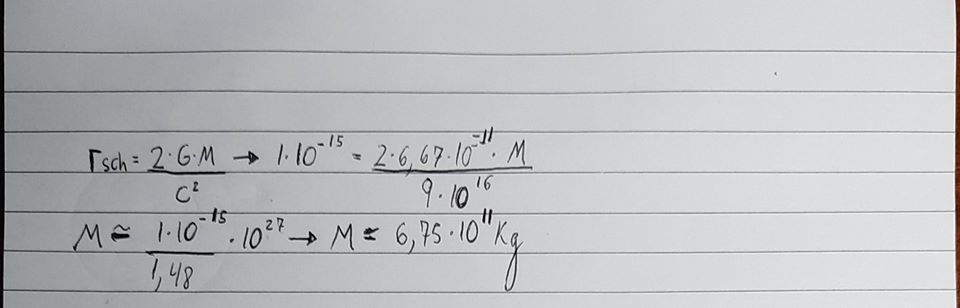
In addition to black holes formed by stellar collapses, there are hypothetical black holes (have not yet been detected) of extremely small sizes, whose formation is speculated to have happened at the beginning of the universe due to fluctuations in density. These black holes are given the name of "primordial black holes". Considering a black hole with schwarzschild radius approximately equal to the radius of an atomic nucleus (~10^-15 m) the mass (calculated in photo 6) is of the order of 10^12 kg. With the size of a particle and the mass of a mountain, a question arises: which theory to use to describe these black holes, the theory of the big (relativity) or the theory of the small (quantum)? Hawking demonstrated that it is necessary to concile concepts of both. In doing so, the calculations of the physicist indicated that the black hole should emit a type of thermal radiation (Hawking radiation). Going against established principles that state that nothing can escape from black holes, Stephen Hawking demonstrated that such bodies are capable of emitting radiation which, consequently, implies that they also have a temperature and a degree of entropy (the latter being, briefly, the level of disorder of a system).
Before we get to Hawking radiation itself, it is critical that we understand the concept of radiation from any body. Thermodynamics tells us that any object with temperature will exhibit a radiation spectrum of a black body. When we heat an object, we increase the kinetic energy (and therefore the thermal energy) of the particles of the object. This energy is then converted into electromagnetic energy and emitted in the form of photons (electromagnetic waves), which characterize the radiation process. The radiation spectrum is the distribution of radiation intensity as a function of the wavelength of the photons emitted by the radiating body (as shown in photo 7, where s(λ) is the intensity of the radiation). Black bodies are ideal objects that absorb any form of radiation and then emit it throughout the radiation spectrum, that is, for various wavelengths.
At the beginning of the 20th century, physicist Max Planck studied the radiation of black bodies in order to associate the light intensity with the "quanta" of light, according to the relation E=h*f. The resumption of these concepts is of paramount importance because black holes exhibit a spectrum of black body radiation, and are still remarkably idealized, since black holes absorb anything (including radiation). Dedicated articles on Max Planck have already been published on the page and website.
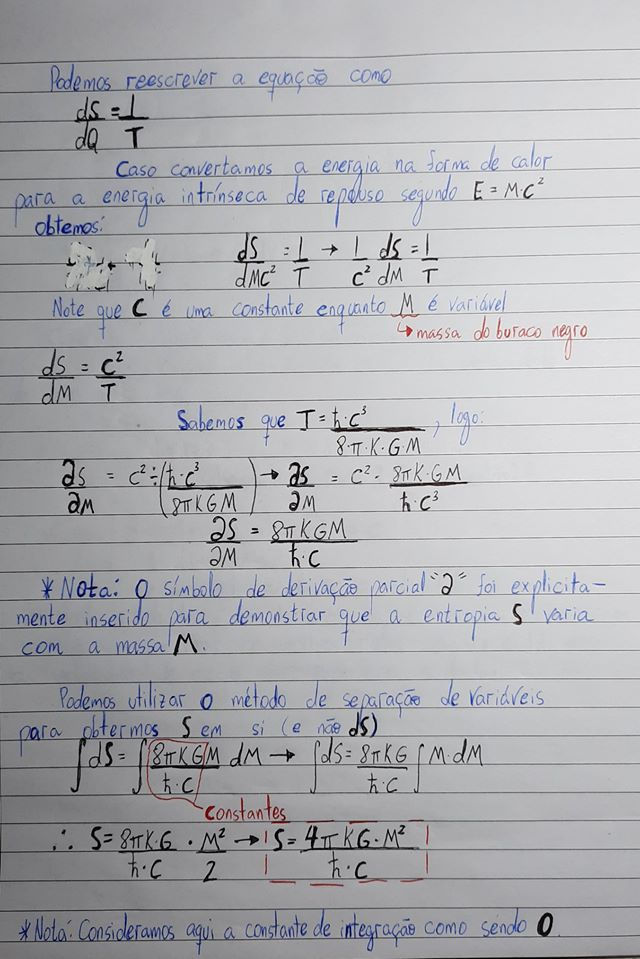
Having understood the general process of thermal radiation, we can proceed to Hawking radiation. The following description, found in Jorge Pinochet's article "The Hawking temperature, the uncertainty principle and quantum black holes", provides a more intuitive and non-rigorous look at black hole radiation, even though it is a physical description distinct from that provided by Hawking. To start, let's consider the aforementioned quantum black holes. We know that the uncertainty principle is given by∆x∆p≥ℏ/2 (as shown in previous articles). We can rewrite it according to photo 8, in order to obtain ∆v≥ℏ/(2m∆x). An electron inside a quantum black hole has a small uncertainty in its position (also shown in photo 8), given the tiny size of the black hole. We assume that the uncertainty in the position is of the order of 10^-15 meters. Considering that the electron mass is approximately 10^-30 kg, we obtain an uncertainty at the speed of approximately 3*10^17 (an extremely high uncertainty, as expected by the Heisenberg uncertainty principle). With ∆v>c we see that the uncertainty in the electron velocity is greater than the speed of light itself, implying a sufficient escape velocity for the electron to "escape" from the black hole. When it comes out of the black hole, the electron is taking away its mass along, and therefore the mass of the black hole is decreased. The continuity of this process would characterize the emission of Hawking radiation. What we have just concluded apparently infers in the violation of relativistic mechanics, which says that no particle can travel at a speed equal to or greater than that of light. However, because we are within the prospect of uncertainty, we cannot measure/observe a particle effectively traveling faster than the speed of light (not violating relativistic mechanics). We can also analyze the situation from other perspective, in terms of the quantum tunneling phenomenon (discussed in the schrödinger equation article). In quantum tunneling, a particle, like the electron, can overcome/penetrate a potential barrier even without having enough energy to do so, which, in our case, translates that there is a possibility that the electron escapes from the black hole. The simple derivation of the Hawking temperature formula and the entropy of the black hole, according to the approach presented, are found in photos 9, 10 and 11). Analyzing T=(ℏc^3)/(8πkGM) we can come to some conclusions: the larger (more massive) a black hole is, the lower its temperature (which implies in the emission of less energetic black body spectrum radiation). Calculations for the temperature of quantum and supermassive black holes can be found in photo 12. As can be seen in the calculations made, the radiation of large-mass black holes is negligible, because the rate of radiation emission is extremely small, while it is easy for the black hole to acquire extra mass by mechanisms such as accretion, which would debunk the "progress" of mass reduction by Hawking radiation. We can also note that as the black hole emits radiation, its mass is progressively reduced, so that the more it loses mass the more radiation it emits (Hawking radiation gets more substantial with time). Black holes take an extremely long time to evaporate; a black hole with the mass of the Sun would take up to 10^67 years while one with the mass of Sagittarius A* (supermassive black hole at the center of the Milky Way) would take around 10^87 years. Still, a proton-sized black hole would take about 10^13 years to evaporate completely (keep in mind that the age of the universe is in the order of 10^10 years). Despite all the conclusions provided, the equation for the temperature of a black hole has a limit, this being the Planck mass, given by m_Planck=√(ℏc/G)≅10^(-8) kg. But what happens when the effects of Hawking radiation pushes the mass of the black hole beyond that limit? The answer is, we don't know for sure. However, Hawking strongly believed that the black hole would simply disappear. It is at this point that the "paradox of information" arises, which will be discussed later.
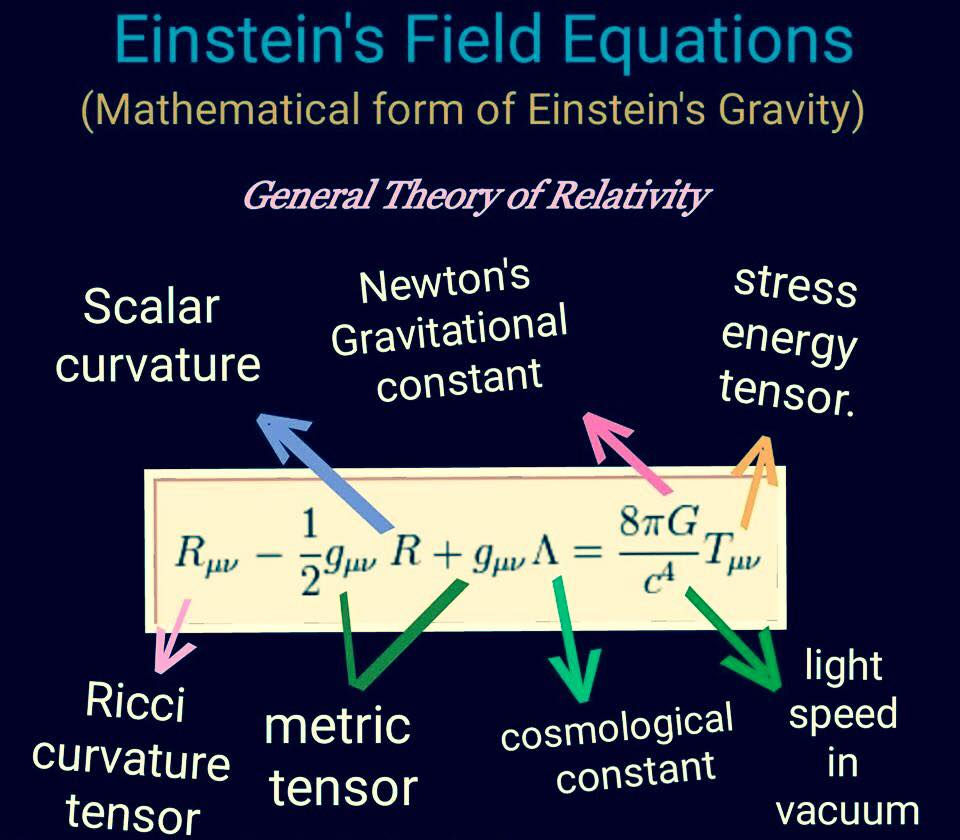
As it evaporates, the black hole gradually reduces its size, that is, the distance between the singularity and the event horizon shortens. The process of shrinking the black hole can be better understood by crediting general relativity. Einstein, in this theory, created a series of equations (10 in total) summarized to a single, given the possible different combinations of dimensions in mathematical objects called tensors. Such equations became known as "field equations" (photo 13). It is known from general relativity that both mass and energy cause space to curve. Furthermore, the element T_μν in the field equations is the so-called stress-energy tensor, which is altered when there is mass reduction caused by Hawking radiation. As energy and/or mass modify the curvature of space, the change in the stress-energy tensor will consequently cause a type of change in the geometry of space, in our case it will be the shrinkage of the black hole itself.
We will now present Hawking's description of Hawking radiation. The vacuum is not exactly empty, since, because of the uncertainty principle, there are quantum vacuum fluctuations, which cause particle and antiparticle pairs to materialize spontaneously separate, join again, annihilating themselves, so that there is no violation in the law of energy conservation (this phenomenon occurs in very short time intervals). Such a process takes place throughout space, including at the borders of a black hole. If one of the particles falls into the black hole (that is, beyond the event horizon), the other particle will no longer annihilate itself with its partner, being now free either to escape the vicinity of the black hole or also to fall into the black hole. From this point we can raise several equivalent interpretations. We can understand the loss of mass of the black hole considering that the particle that first fell into the black hole had negative energy, or that the particle that "escaped" the black hole did so at the expense of the energy provided by the black hole itself, again, following E=mc^2, so that there is no violation of the energy conservation law (the black hole provides the necessary energy to the outside particle escape, through its mass, according to the mass-energy equivalence mentioned). In this case, for a distant observer, the escaping particle would have seen to be emitted by the black hole itself. Again, it is emphasized: there is no consensus on the physical process itself, but the multiple interpretations are equivalent.
One of the factors that prevented Stephen Hawking from being awarded a Nobel Prize was the difficult task of detecting Hawking radiation. This is because, as it has been discussed, Hawking radiation is very succinct, making detection by equipment on Earth virtually impossible. In addition, cosmic microwave background contributes to "masking" /hiding the thermal spectrum emitted by black holes, since the background radiation covers the entire space by a characteristic temperature of practically uniform 2.7 Kelvin. However, in 2019 scientists from Israel were able to conduct an experiment analogous to Hawking radiation, in which they obtained results prescribed by predictions made from the studies of Stephen Hawking (there is an article about this experiment on the page and on the website, entitled "sonic black holes").
In a final analogy, Hawking radiation would be something as if the
pearl could emit heat out of the oyster. Thus, we conclude that, although black holes are endowed with an integral mystery, they, in Stephen Hawking's own words, are not so black.
Photo 1: Gargantua, black hole from the film Interstellar
Photo 2: Schwarzschild radius
Photos 3 and 4: Derivation of escape velocity
Photo 5: Escape velocity for black holes
Photo 6: Calculation of mass according to the Schwarzschild radius
Photo 7: Radiation spectrum of a black body
Photo 8: Implications of the uncertainty principle
Photos 9, 10 and 11: Derivation of formulas for the temperature and entropy of black holes
Photo 12: Calculation of the temperature of black holes
Photo 13: Einstein field equations
Reference material:
Black Holes, Hawking Radiation, and the Firewall (Noah Miller)
The Hawking temperature, the uncertainty principle and quantum black holes (Jorge Pinochet)
The universe in a nutshell (Stephen Hawking)
A brief history of time (Stephen Hawking)
Black Holes (Stephen Hawking)
Origens (Neil deGrasse Tyson)
Physics for scientists and engineers volume II (John W. Jewett e Raymond A. Serway)
50 Quantum Physics Ideas You Really Need to Know (Joanne Baker)









Comments