


Big Bang (english version)
- Pedro

- May 12, 2020
- 6 min read
Updated: Jun 15, 2020
It all started with the Big Bang. The famous "Big Bang" was the primordial event of the universe. Contrary to what is often thought, the Big Bang was not a catastrophic explosion in space, and thats because space itself had not yet been created. The Bang was an explosion of space rather than an explosion in space. After the Big Bang occurred, the space itself began to be created and time began. According to Stephen Hawking, questions such as "what happened before the Big Bang?" have no meaning because time did not exist before the Big Bang; it is similar to a child looking for a toy that he/she does not have, the little one will never find it. As for the Big Bang itself, it came from a singularity, similar to those of black holes, in which all matter in the universe was contained in an infinitesimally small volume.
The dynamic immediately after the Big Bang can be described with one word: chaotic. Literally, the first second defined the laws of nature in the way they are observed today; in other words, the universe, in its first second of life, defined physics, chemistry, biology and mathematics. In the so-called "Planck era", all the properties of the universe (mass, length, electrical charge, temperature, and time) were contained in the "Planck scale". The Planck era is as far as you can go back in time (up to 10^-43 seconds after the "Bang"). The temperature of the universe was around 1.4*10^32 kelvins (the highest that ever existed or will exist) and its size was approximately 1.6*10^-35 meters. In the described configuration, the fundamental forces of nature (strong nuclear force, weak nuclear force, electromagnetic force and gravitational force) were unified into one force (there are caveats as to the previous junction of gravity with the others, given its difficult theoretical unification). In the beginning, the universe was filled with a soup of fundamental particles (such as quarks, antiquarks electrons and positrons*) which frantically annihilated each other, given the immense rate of interaction due to the small size of the newly conceived universe. The product of such annihilations was the production of gamma rays, according to the transformation of mass into energy governed by the equation E=MC^2.
But what about the proportion of matter-antimatter? Would they be the same? It would not be possible, otherwise the universe would be composed only of photons (due to the annihilations). What made matter triumph over anti-matter, causing galaxies, stars, planets and people to be composed of matter (not anti-matter) was a very light asymmetry. For every 1,000,000,000 anti-matter particles there were 1,000,000,001 particles of matter. One of the results of the expansion of the universe was the sharp decrease in temperature, allowing quarks to group into trios (called hadrons) thus forming the familiar protons and neutrons, fundamental blocks for the constitution of all celestial bodies. Getting to the mark of the first second post Big Bang, the first nuclei of the lightest and simplest elements (hydrogen, helium and lithium) were created by the reconciliation between protons and neutrons, made possible by the cooling of the universe. Later, the free electrons slowed down and then were captured by the atomic nuclei previously formed, thus generating the first elements of the universe. This process was called the "nucleosynthesis of the Big Bang". Only the three elements mentioned were created on the Big Bang (the rest are/were due to stellar activity).
When Einstein developed the theory of general relativity, he adopted that the cosmological constant (component of his field equations) was equal to zero, which would mean that the universe would be stationary (it would not evolve). Such a vision implied that the universe could either have existed forever or have arisen at one point and maintained its shape ever since. Later, however, evidence (such as those provided by Edwin Hubble) showed that the universe was expanding, that is, it had a starting point and evolved from it.
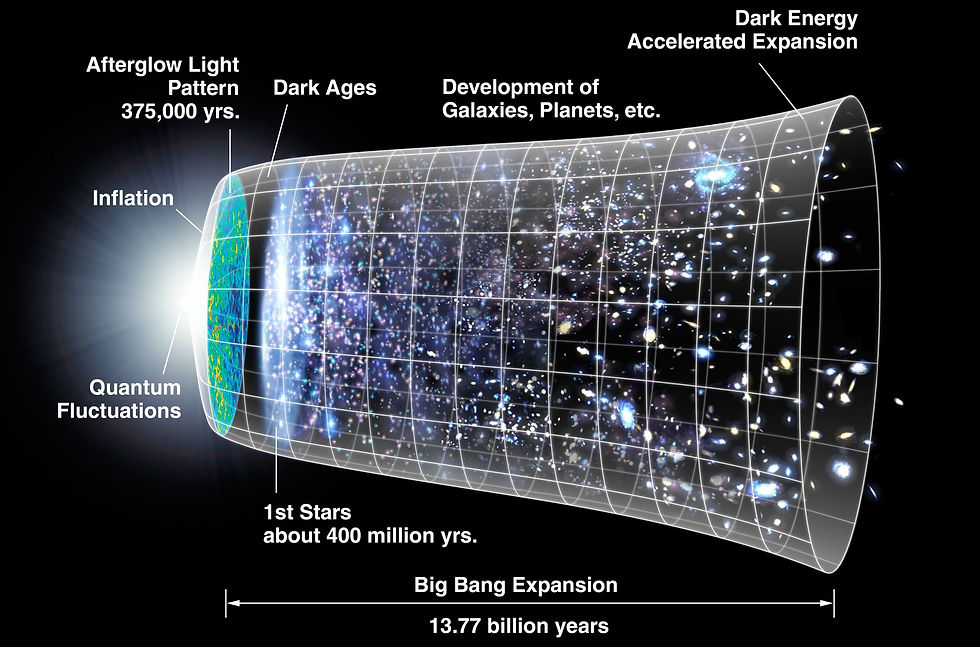
Thus, since the Big Bang event, the universe is in the process of expansion, resulting in the dilution (decrease of concentration) of energy and matter throughout the growing space. The phenomenon of expansion has made - and still makes- photons lose energy, suffering a redshift. The photons of the primordial universe (gamma rays) have undergone a redshift so intense that they are currently in the range of the radio wave spectrum. An analogy is useful for understanding how this change occurs. In that analogy, the universe is considered as a balloon under constant filling. Photons, with defined wavelengths, characterising gamma rays, are on the surface of the "balloon universe". As the universe expands (the balloon inflates), the wavelengths of the photons will increase, so that the photons get a decrease in energy (according to the fundamental equation of the waves λ=c/f). These photons currently in the microwave range constitute the so-called cosmic background radiation (CMB). The vacuum, at any point in space, has a characteristic temperature of 2.725 K, result of the CMB, which is evenly distributed throughout the universe (actually there are a few locations with tiny variations in temperature). Cosmic background radiation is, in simple terms, the fossil of the light of the Big Bang era. The expansion of the universe, accompanied by the decrease in its temperature, also caused the fundamental forces of nature to separate; first there was the separation between electroweak and strong nuclear forces and then the electroweak was divided into electromagnetic and weak nuclear forces.
But what favors/enables the expansion of the cosmos? The answer lies in the most abundant component of the universe: dark energy. Responsible for about 70% of the composition of the universe, dark energy increases the expansion of the universe over time, because as more space/vacuum is created, more quantum fluctuations arise, which generates greater external pressure, leveraging expansion. Galaxies that are visible today will disappear into the sky over the next billions of years, with speeds higher than that of light. But how would that be possible? The theory of relativity restricts that bodies travel through space at lower speeds than light, but in the situation considered, space itself (and not the galaxies contained therein) would be expanding at speeds higher than that of light, which does not contradict Einstein's theory.
From the second 10^-36 to 10^-32 the universe underwent a sudden expansion; in this tiny time interval the size of the universe increased by a factor of 10^26. This period of exacerbated growth was called inflation. After its end, the universe continued to expand, but at a reduced rate compared to the inflation era.
The initial singularity from which the universe arose had infinitesimally small dimensions. The science that governs the behavior of bodies of minute sizes is quantum mechanics. However, the magnitude of the mass involved is extreme (it is the mass of the entire universe), and the science that governs the behavior of massive bodies is general relativity. That's the breaking point of science. In singularities, whether the "conventional" (from black holes) or that of the Big Bang, the laws of nature become distinct and mysterious. But even with such limitations, it is possible to speculate how the universe did...Bang? Stephen Hawking stated that, given the "size" of Big Bang's singularity, it was subject to exclusive phenomena from quantum mechanics. The universe, according to Hawking, may have been the result of a quantum vacuum fluctuation, which would explain the "spontaneous" emergence of the cosmos. In respect to the negative energy generated by such quantum vacuum fluctuation, it would be "stored" in space itself. The universe, in this view, would be a great storage of negative energy.
It is important to highlight the evidence of the occurrence of the Big Bang, due to many people thinking that the Big Bang theory is merely a scientific hypothesis. Among the many evidences, one can highlight: the cosmic background radiation, a mark of the Big Bang resonating to this day; the spacing of galaxies, which indicates that they were closer in the past; the majority incidence of light elements (created by the nucleosynthesis of the Big Bang) in the universe and the absence of stars older than 13.8 billion years (age of the universe), which reinforces the fact that the universe began in a finite time in the past. Finally, the Big Bang, like all scientific theories, are not arbitrary ideas or opinions of scientists, but rather they are facts, and their incontestableness is supported by evidence from observations, tests, validations and the application of the scientific method in general.
The photo presents the evolution of the cosmos, including the chaotic post-Big Bang period described in the article.
Reference material:
The evolving universe (S. George Djorgovski)
Origens; Astrophysucs for people in a hurry (Neil deGrasse Tyson)
The universe in a nutshell; A brief history of time (Stephen Hawking)
50 astronomy ideas you really need to know (Giles Sparrow)
Do átomo ao buraco negro (Schwarza)



Comments